A Victory for Y’all?

August 19, 2025
Posted by Jay Livingston

I thought I’d given up blogging, but when a legitimate source — in this case NPR — says something that is just flat-out wrong, I can’t help myself. 

It was on All Things Considered about a month ago, a piece by Bill Chappel (here) on the word y’all. It begins:

Sorry, yinz. Fuhgeddaboudit, you guys: In the past 20 years or so, yall”  has gone from being a Southernism to become America's favorite way to use the second person plural, according to linguists. Y'all has won,”  says Paul E. Reed, a linguist at the University of Alabama who studies Southern American English and Appalachian English. Its expanded much more outside of the South”  among people who are under 40 years old, he says.

One thing that he says is true. Younger people outside the South have picked up y’all, probably because it sounded cool when they heard Black people use it. But they use  it only as a “vocative” stand-alone like “Hey, y’all”  Or as in this photo — from a LPGA Classic in Mobile, AL — that accompanies the online version of the NPR piece.


More likely they will use it for emphasis or almost a challenge. “That’s what I’m talkin’ about, y’all.” 
But non-Southerners do not use it as part of a clause in a sentence. They do not say, as a true Southerner might, “What did y’all do last night?” or “It’s good to see y’all again.”

No, the victory y’all has won is very limited. The real winner is “you guys.” That’s what we, especially those under fifty (I’m guessing), use when we want to distinguish second person plural (you guys) from second person singular (you). 

I find it hard to believe that the academic linguists Chappell consulted did not make this distinction. I have no formal training in linguistics, so I checked with Claude.AI, who agreed with me and went a bit further.

This is a perfect example of how linguistic claims can sound authoritative but miss crucial distinctions in actual usage patterns. The article treats yall as if it has fully replaced other plural forms across all grammatical contexts, when in reality its spread has been much more limited - primarily to vocative/address functions rather than becoming a true grammatical replacement for plural you.

Institutions as Guard Rails

November 6, 2024
Posted by Jay Livingston

Half a score and seven years ago, I said something (here) that I am now rethinking:

Authoritarianism has always had some allure to some Americans, especially in times of crisis. In the Depression, people like Huey Long and Father Coughlin played to this sentiment with some success. But in the end they failed, and most people today have never heard of them. To some extent, it’s because of the eventual good sense of the American people. But more likely, our success in avoiding a Godfather government stems from the enduring institutions of our society and government. [emphasis added]

Now I am not at all sure about those institutions.

I was blogging in response to a HuffPo piece by Philip Slater, who was dismayed by the popularity of Mafia media — The Godfather, The Sopranos, Goodfellas, etc.

Americans love the mafia because it represents a totally authoritarian system in which mistrust, cynicism, slavish obedience, and rash, violent decisions prevail. That seems to be the kind of world most Americans are looking for today.

But Slater was thinking not just about the movies but about real-world politics as well:  “Americans were so willing to elect and re-elect the most secretive, despotic, and anti-democratic administration in the history of our nation.” He was talking about George W. Bush.

My take then was that what we like to see on the screen is not always what we want in real life.

Here is a system that rewards its virtues —loyalty, respect, honor — and punishes transgressions surely and swiftly. If your real world is full of uncertainty and moral ambiguity, if virtue is not always rewarded and wickedness not always punished, you might take comfort at the end of the day in the unclouded vision of the media’s mafias.

Now I’m thinking about that final sentence of my 2007 post, the one about “the enduring institutions of our society and government” that might act as guard rails.

America has now a elected a man who has already tried, with some success, to undermine or dominate the institutions that might constrain him — the courts and the rule of law, the legislature and the electoral process, the media. And he has promised to use the full powers of the presidency to continue this project, replacing the professionals in federal agencies with people chosen not for their experise and competence but for their loyalty.

What institutions are left?

The Party's Over

September 21, 2024
Posted by Jay Livingston

“Two pair wahr,” said the young woman next to me in the Place Aristide Briand in Carpentras. We were both there for the marché aux truffes, a truffle market held every Friday morning in the cold months. The waitress at the restaurant Thursday night had told me about it, so Friday morning I was up early to make the half-hour drive. I was early. A few dozen people were standing in a loose circle. The farmers, with their baskets of truffles and their hand-held balance scales, stood in the center. At 8:45, someone blew a whistle and trading started.

I had come just to see the market and take some photos, but I started talking with a couple of young women standing near me, and after a few minutes they were helping me buy a half kilo of truffles. I told them that I wanted to take them back to my friend in Paris, but I didn’t think it was a good idea to keep them for several days in the paper bag I was now holding.
    
They told me that I should go to the grocery store and get some rice, then to the droguerie (housewares store) and get “two pair wahr.” My so-so French had been adequate to the task so far, but here was a French word I did not understand. “Two pair wahr,” she repeated, and mimed prying a lid off a container.

Tupperware. Of course. You put the truffles in and fill it with rice. It won’t smell up the car, and when you do get back to Paris, whatever dish you decide to use the truffles in,, you’ll also have the best tasting rice you’ve ever had,

It was the only piece of Tupperware I ever bought.

Last week, Tupperware filed for bankruptcy.

Jeopardy III: Losing Their Religion. Again.

July 1, 2023
Posted by Jay Livingston


I didn’t see this when it happened nearly three weeks ago. None of the three Jeopardy contestants knew “hallowed be thy name.”


Nor, until now, was I aware of the distress and outrage it provoked.

For me, it was déja vu.

I was on Jeopardy fifty years ago. At the studio, before the taping began, they had some of the contestants do a practice round. Presumably, this was to help us feel comfortable with the cameras and lights and other aspects of the set. I was not one of those selected, so I sat nearby and watched. One of the categories on the board was The Bible.

“OK, let’s go,” came the voice from the control room. They ran through a few questions, and then a contestant, after answering a question correctly, asked for The Bible.

The plate with “$10"* on it slid up revealing the question which the host then read: “In the Book of Matthew, he says, ‘Suffer the little children to come unto me.”

Silence. Nobody rang in. Then over the speakers came the deep voice from the control room: “They don’t come any easier in this category, people.”

---------------
* Yes, $10. The dollar values of questions then were 1/20 what they are now. For more on my Jeopardy appearances, see these earlier posts.

Not Ken Jennings, But . . .

Jeopardy II: Audiences — à la Goffman and ABC-TV


To Serve and Protect and Empathize

May 3, 2023
Posted by Jay Livingston

A friend of mine here in New York was the victim of a property crime, a larceny. The bad guys had broken into his car and taken whatever wasn’t locked down, mostly books as I recall (this happened a long time ago). He went to the local precinct to report it. Eventually the desk sergeant acknowledged his presence. “Somebody broke into my car and took all my stuff.”

“So what do you want me to do about it?” said the sergeant.

The officer’s response is understandable and quite reasonable. There’s no way the thief could be caught or the property recovered. Besides, this type of crime happened frequently. To fill out the paperwork or do anything would just be a waste of police time. My friend knew all this, but he was still not happy about the way the cops treated his victimization.

I remembered this anecdote when I saw some data from Portland showing low levels of satisfaction with a crime reporting system there. It also reminded me of the previous post about satisfaction with responses to medical questions. When people seek immediate medical advice online, they are more satisfied with the responses of a non-human (ChatGPT) than with those of a doctor. Doctors were five times more likely to get low ratings for both the quality of the information and the empathy conveyed. Three-fourths of their responses were rated low on empathy.

Something similar could be happening when people are victims of crime. In Portland, as in many cities, victims of non-violent crimes can use the online reporting system rather than calling the cops. Most people find the system easy to use, and it frees police resources for other matters, but so far it’s not getting high marks. Only 16% of those who used it said they were “Satisfied” and nearly three times that many said they were “Dissatisfied.”

Could ChatGPT help?  As with medical reporting, the crucial factor is whether the police seem to care about the case. People who received a call or email from the police in response to their online report were twice as likely to be satisfied, even though the callback sometimes came weeks after the victim had filed the report and even though many of the victims or property crime merely want a case number for insurance purposes.

ChatGPT or some similar program could send this kind of email and respond to questions the victim might have. I’m not sure what ChatGPT’s initial message would sound like, but it wouldn’t be, “So what do you want me to do about it?”  Putting ChatGPT on the case wouldn’t have any effect on the crime rate or the clearance rate, but it might make a difference in how people thought about their local police.

Your GP or ChatGPT

May 1, 2023
Posted by Jay Livingston

Help. A couple of hours ago, I swallowed a wooden toothpick that the cook had missed when removing them from the stew he’d made. It wasn’t that long, an inch or so, and it couldn’t have been very sharp since I didn’t feel it much when I swallowed it. But can it be serious or even fatal?

A question similar to this was posted on Reddit’s r/AskDocs forum, where doctors or other healthcare professionals post answers. Here are two responses.

If youve surpassed 2-6 h, chances are theyve passed into your intestines. Which means it can’t be retrieved easily.

Many people can swallow razorblades and toothpicks without issue. In case you develop stomach ache, then don’t hesitate seeking out an emergency room, and remember to point out the swallowed tooth pick.

For now, they won
t be doing much.


Its natural to be concerned if you have ingested a foreign object, but in this case, it is highly unlikely that the toothpick you swallowed will cause you any serious harm.

Toothpicks are made of wood, which is not toxic and will not cause poisoning. However, it is possible for a toothpick to cause injury if it becomes stuck in the throat or if it punctures the digestive tract. However, this is unlikely to happen with a dull, cooked toothpick that is only 2 cm long.

If you are experiencing any discomfort or symptoms such as abdominal pain, difficulty swallowing, or vomiting, it is important to contact a health care provider for further evaluation. However, if you are not experiencing any symptoms, it is safe assume that the toothpick has passed through your digestive system and you do not need to concerned.

It
s always a good idea to be cautious when consuming food and to remove any foreign objects before eating. It's understandable that you may be feeling paranoid, but try not to worry too much. It is highly unlikely that the toothpick will cause you any serious harm.

How would you rate the quality of each response on a 5-point Likert scale (very poor, poor, acceptable, good, or very good)?

How would you rate the empathy or “bedside manner” of each response (not empathetic, slightly empathetic, moderately empathetic, empathetic, and very empathetic)?

The first response is from an actual doctor. The second is from ChatGPT.  Which did you rate more highly?

Chances are that your evaluation was no different from those of a team of three licensed healthcare professionals who reviewed 200 sets of questions and answers. On measures of both quality and empathy, ChatGPT won hands down. (The JAMA article reporting these findings is here.)

On a five-point scale of overall quality, the ChatGPT average was 4.13, Doctors 3.26. (On the graph below, I have multiplied these by 10 so that all the results fit on the same axis.) On both Quality and Empathy, Doctors got far more low (1-2) ratings (very poor, poor; not empathetic, slightly empathetic), far fewer high (4-5) ratings.

The great irony is that the doctors tended to be impersonal while the machine (ChatGPT) responded to the patient as a person, not just a symptom reporter.

People who ask medical questions are worried. If you have something going on with your body that seems wrong, and you don’t know what it is, you probably are going to have some anxiety about it. So ChatGPT might begin with a general statement (“It’s always best to err on the side of caution when it comes to head injuries,” “It’s not normal to have persistent pain, swelling, and bleeding. . . “) or an expression of concern (“I’m sorry to hear that you got bleach splashed in your eye”). The doctors generally focused on the symptom, its causes and treatment.

Doctor responses were considerably more brief than those of ChatGPT (on average, 50 words compared with 200). That’s partly because of time. If doctors were at all concerned with an efficient use of their time, they couldn’t turn out the longer responses that ChatGPT generated in a few seconds.

But I think there’s something else. For patients, the symptom is new and unusual. They feel worried and anxious because they don’t know what it is. But the doctor has seen it a thousand times. It’s routine, not the sort of thing that requires a lot of thought. Here’s the diagnosis, here’s the recommended treatment, and maybe here are some other options. Next.

A Boy’s View of the Boys of Summer

April 28, 2023
Posted by Jay Livingston

The previous post was about the belief that a ballplayer with a modicum of talent should keep at the game regardless of the sacrifices he has to make or his realistic probability of success. I added a Durkheimian gloss -– that this belief and its attendant rituals are essentially non-rational; they are a mechanism for group cohesion. The baseball-as-divinity belief serves the purposes of the group as a group, not of its individual members.

I myself once held this belief. Of course, I was fairly young at the time. Two moments stand out in my memory.

1.  When I was young, probably at the low end of Little League age range, my father let me tag along once when he was meeting casually with a man he had some kind of business deal with, buying or selling steel not that it matters. The man’s name was Mickey Weintraub, and although he was probably in his forties at the time, he looked much younger. He was tanned and handsome, and he just had one of those eternally young faces. He had also been a professional baseball player, an infielder.

He had spent years in the Giants farm system, Double-A and Triple-A minor leage teams, but had never quite been able to make it to the majors. Good field, no hit, I think. The Giants were still in New York then, and they figured that a player named Weintraub in the line-up would boost attendance at the Polo Grounds. So they were willing to keep giving him a chance.

“Every year, I’d go to spring training in Arizona, and they’d ask me ‘How old are you.’ And every year, I’d say ‘twenty-four.’ I could have gone on like that forever.”

“Why didn’t you?” I asked. I was incredulous that he had ever stopped.

“You can’t fool your legs.”

At age nine, I didn’t understand about legs and how 32-year old legs might be different than 24-year old legs. But what I really didn’t understand was why someone would stop playing baseball and go into the steel business.

2.  When I was twelve or so, I went with my parents to visit my younger brother at summer camp. One of the counselors there had until recently been a pitcher for Montreal, which was then the Dodgers’ Triple-A farm team. He was what we would have then called a “light-skinned Negro,” and tall, like the Dodgers’s ace Don Newcombe but better looking. He was also apparently not quite as good as Newk; he had not been called up to the majors.

Somehow, I wound up playing catch with him. We had thrown the ball back and forth for a while when he said, “Can you catch a curve ball?”

“Sure,” I said. After all, some of my friends that I’d caught could throw pitches that broke a few inches. He took a short wind-up, leaning back then bringing his body and arm forward. The ball seemed to be headed for my left shoulder or maybe a little higher when suddenly it spun downward and to the right, and next thing I knew it was sailing past my right leg. I could hardly believe what I’d just seen. Embarrassed, I turned and trotted back to the bushes where the ball had finally stopped rolling.  

I don’t remember if we kept playing or if he threw any other curve balls and if so whether I caught them. I just remember thinking: How could anyone who can throw a pitch like that not keep trying to get in the Dodgers’ rotation?

I heard from one of the other counselors that he was going to med school.

Durkheim at the Bat: The Elementary Forms of Baseball Life

April 27, 2023
Posted by Jay Livingston

Drew Maggi was a 15th-round draft pick by the Pirates in 2010. He played in the minor leages for thirteen years — Double-A and Triple-A farm teams of a half-dozen different MLB franchises, 1,155 games, 4,494 times at the plate,  Yesterday, three weeks shy of his 34th birthday, he made his first appearance in a MLB game. He was a pinch hitter in the bottom of the eighth inning in a game the Pirates (the division-leading Pirates!) were winning 8-1. He struck out.

The fans cheered. They had cheered even more loudly the moment he was announced. All the Pirates in the dugout had cheered and applauded. And after the game, he was interviewed on the field and on the jumbotron just as if he had hit a walk-off home run.


I imagine Durkheim watching all this, sitting somewhere in the upper deck, thoughtfully sipping a beer. Yes, this is a celebration of Drew Maggi, he thinks, but rituals — and surely this is a ritual — even when they focus on some central individual, are performed not just by the group but for the group. What’s being extolled here is not Drew Maggi, it’s baseball itself. The important point is that we are acting here not as individuals doing what’s in our self-interest, but as members of the group, doing what’s necessary for the group.

Groups come together for these rituals often in response to some threat. External threats are obvious. In the face of threat from another team, we wave our yellow towels. Internal threats are harder to see, but when you see people reacting as if to a threat, and they are not under attack, the threat is probably internal. Quitters are a good example.

A quitter is a threat to the group not because the group is left with one less team member. What’s at stake is the whole premise of the group, because what the quitter is saying is that the very basis for the group  is silly or stupid or harmful. That’s why group reactions to quitters can seem way out of proportion. Two years ago, I wrote (here)  about the reaction, especially on the political right, when Simone Biles, for perfectly understandable reasons, chose not to participate in the Olympics. “Quitter,” “selfish psychopath,” “very selfish ... immature ... a shame to the country,” “selfish, childish, national embarrassment.” Jason Whitlock at The Blaze wrote about Biles’s “felonious act of quitting.” Yes, a felony.

Drew Maggi is the other side of this coin. Minor league players have about a 10% chance of making it “to the show,” and even those odds dwindle with age. In sports, thirtysomethings are not exactly hot prospects. The annual salary is less than $30,000 (Triple-A minimum is $700 a week). As for working conditions, the principal attraction is that you get to play baseball. A lot. The sensible thing for a 34-year old man who for thirteen years has never gotten to the major leagues would have been to quit. But he did not quit. And we the group, we fans and players, raise Drew Maggi up as the focus of this ritual because he symbolizes the reassuring idea that despite all that, baseball is worth it.

Durkheim drains the last of his beer as the fans file for the exits. This spontaneous ritual in PNC Park, he thinks, has the same function as nearly all other rituals: to uphold the fundamental idea of the group and to reaffirm each participant as a part of that group.


Mrs. Maisel Yet Again — 1961 Talking Like It’s 2011.

April 18, 2023
Posted by Jay Livingston

Five years ago, I posted here about the language anachronisms in “The Marvelous Mrs. Maisel.” That post (here) remains the most visited page in this blog, the number of views now approaching 20,000. Last night I watched the first two episodes of Season Five, and I have the same question that I had five years ago with Season One: How can they let these obvious anachronisms make it into the final script?

In Season Five, the year is 1961, and Midge has taken a job in the writers’ room for a TV show much like The Tonight Show. She was reluctant to take the job – she’s a performer, not a writer — and on her first day, she calls her manager Susie to ask for advice.

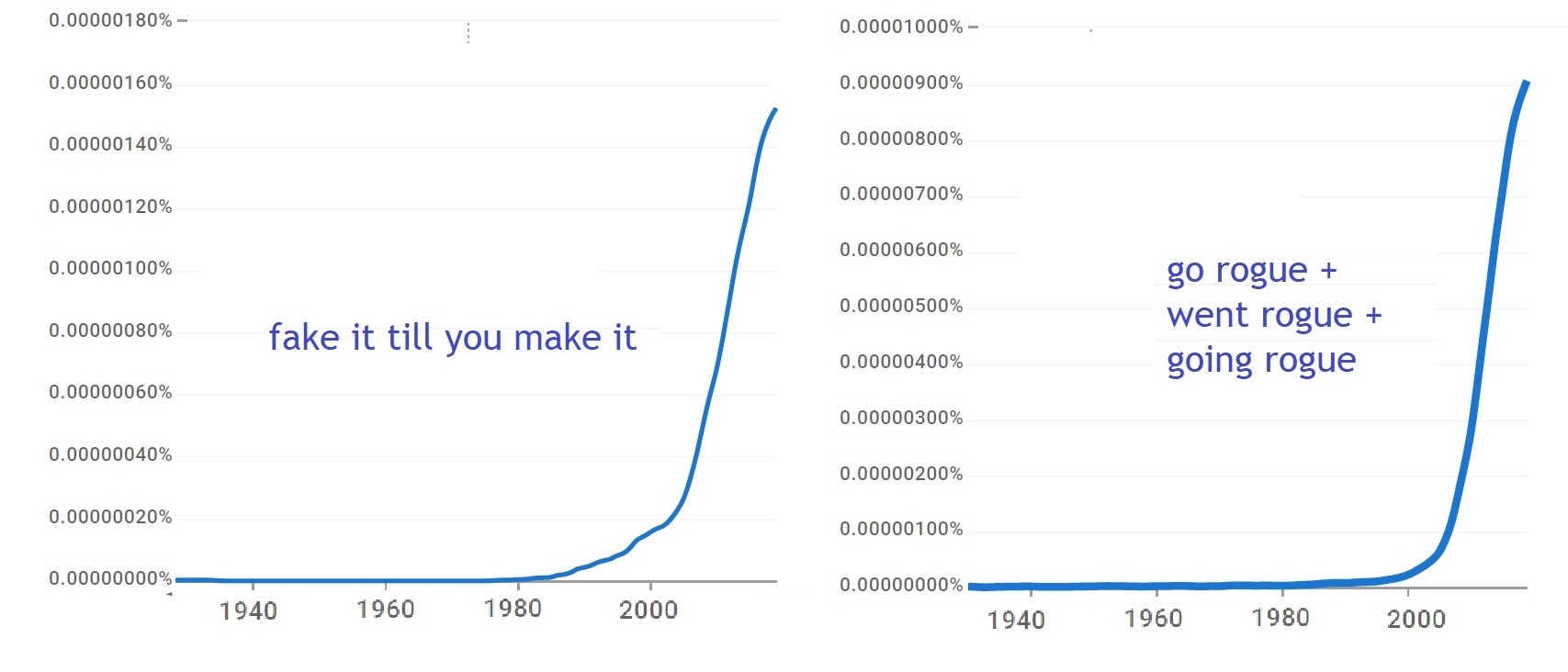
Fake it till you make it may be good advice, but nobody used that phrase in 1961. Nobody. Nor did anyone talk about “going rogue.” But in Episode One, Midge tells Susie, “We had a plan, then I went rogue.”

I ran these phrases by Google nGrams. Here are the results:

(Click on the image for a larger view.)

These phrases did not exist in 1961. Yes,the nGrams data is from books, and trendy phrases turn up in speech — in conversations, on television — before they appear in print, so we should allow for some lag time. A few years perhaps, but not a few decades.

There were others you can find on nGrams: out of the loop, track record, not on the same page. These too arrived much later in the century. Other words in Season Five just sounded wrong --- at least to my ears, and my ears were around in 1961 —  but I had no quick way to check them: not gonna happen, and suck meaning to be of poor quality.

In that 2018 post, I quoted Amy Sherman-Palladino, co-creator and chief writer of the show saying that she hired a “delightful researcher who has like twelve masters degrees in everything in the world” and who questions things that don’t sound right. Sherman-Palladino herself says, “The last thing I want to do, when everyone is making sure that the piping on the wall and the colors are all correct, is . . . come in and throw in a bunch of dialogue that’s not appropriate.”

But the glaring anachronisms remain, and I’m still puzzled.

Mimi Sheraton and Me

April 10, 2023
Posted by Jay Livingston

Mimi Sheraton, long-time food critic for the New York Times, died last week.

It may be difficult now to appreciate just how big a deal Mimi Sheraton was.  In the late 1970s and early 80s, food and restaurants had become an important part of the cultural landscape. Huge steaks and the like were for men with a lot of money and not much of a palate. On the rise were nouvelle cuisine and authentic ethnic restaurants. More important, information about these places was highly centralized. In 1975 when Mimi Sheraton started at the Times, there was no Zagat’s and of course no Yelp or the  dozens of online restaurant review sites today. There was Mimi, and everybody knew who she was.

Our paths crossed once, briefly many years ago. I was on jury duty one morning in early January back in the early 80s – civil court, downtown Manhattan. A woman was suing the movie theater where she had fallen or tripped, presumably suffering some injury. Civil court judges, to make more efficient use of their time, were not present for voir dire, at least not in this case. The lawyers conducted voir dire themselves. If some dispute arose, they would pause the proceeding and walk down the hall to see the judge.

Even to non-attorney eyes, these lawyers did not seem like the brightest lights in the room. One of my fellow jurors, a philosophy professor (it was Winter Break for him too) said to me, “If my students asked such questions, I would fail them.” It also seemed they weren’t listening closely to the answers.

The plaintiff’s lawyer was questioning a prospective juror, one Mimi Falcone. “And what do you do Miss Falcone – is it Miss or Mrs.?”

“I’m a food critic. I write a column under the name . . .”

But the lawyer wasn’t listening. As soon as she said she said “food critic,” he started speaking over her.  “Where do you write your reviews. I mean if you were someone like Mimi Sheraton. . . .”

She interrupted him firmly. “I am Mimi Sheraton.”
 

From there, things went even further south. “Are you familiar with the Coronet Theater?”

“I’m not sure which it is,” she said, ‘The Coronet or the Baronet” (the two theaters stood side by side on the Upper East Side), “but one of them has this terrible staircase.”

Ms. Falcone was not selected for the jury.

But I was.. Go to lunch, we six jurors were told, and after lunch we’ll begin the trial. But before we left, we approached Mimi Sheraton and asked her to recommend a restaurant in Chinatown. She did, and we went. It was more expensive than most Chinatown lunch places, but most of us could afford it, and for the one who might have chosen a more modest place — an underpaid secretary as I recall – the rest of us shared her part of the bill.  The food was great, and different from much Chinatown fare. Mimi had not steered us wrong.

We returned to the courtroom ready to hear the case only to be told that the parties had reached a settlement. That’s often happens in civil cases. But most civil court juries don’t get a personal recommendation from Mimi Sheraton.

Lyin’ Eyes

March 22, 2023
Posted by Jay Livingston

During the protests over the killing of a Black man in Kenosha, WE, CNN reported that the demonstrations were “mostly peaceful.” Unfortuantely, the background visual behind the reporter showed a lot of fire.

The right-wing had a field day.

Technically, CNN was correct. The demonstrations were mostly peaceful. But that didn’t matter. What mattered were those who posed the greatest threats, the ones who torched those buildings.

And now we have Tucker Carlson (here) saying that the “overwhelming majority” of people who invaded the Capitol on Jan. 6, 2021 were “peaceful.” Carlson acknowledges that a “small percentage of them were hooligans. They committed vandalism.” But the overwhelming majority “were orderly and meek. These were not insurrectionist. They were sightseers.”  He has the tape to prove it. In fact, he has all the tape – 41,000 hours. The Republicans on the House committee gave it to him to edit as he sees fit. No doubt, the Carlson cut will show very orderly people, meekly trying to overturn an election that their candidate lost by seven million votes.

Technically, Carlson is correct. The  overwhelming majority —especially if you expand the denominator to include the tens of thousands of Trump supporters who came to the rally that day but did not invade the Capitol — were not hooligans. But again, the numbers don’t matter. What matters are the violent insurrectionists. This small minority are important because they posed the greatest threat to the democratic institutions of the government and to the police who were trying to protect the Capital and the Representatives and staffers who work there. That’s why, as Carlson laments, “you’ve seen their pictures again and again.”  But who are you gonna believe – Tucker Carlson or your lyin’ eyes?

There’s a larger and more complex question topic in these demonstrations — the relation between the overwhelming majority and the extreme minority. It’s far too complex to go into here, especially in the case of Jan. 6.


Check and Double-Check Your Conservatism

March 15, 2023
Posted by Jay Livingston

In 2014, the Princeton Tory, the campus conservative publication, ran a piece condemning the phrase “check your privilege” and the ideas behind it (here). The author, Tal Fortgang complained that “the phrase . . . assumes that simply because I belong to a certain ethnic group I should be judged collectively with it,”

Check-your-privilege diminishes “everything I have personally accomplished, all the hard work I have done in my life” and “ascrib[es] all the fruit I reap not to the seeds I sow but to some invisible patron saint of white maleness who places it out for me before I even arrive.”

This is standard conservative thinking — the individual-reductionist belief that those who wind up in elite schools and eventually in high-paying jobs have gotten there solely on the basis of their own personal qualities like intelligence, perseverance, grittiness, etc. Privilege — the social class of their parents — had nothing to do with it. They are all self-made successes. (This conservative take makes an exception for Blacks, women, and other previously excluded groups. They have reached their position not through ability and virtue, but through favoritism in the form of institutional programs emphasizing diversity, equity, and inclusion.)

So you can imagine my surprise when I read George Will, a reliably conservative columnist, making basically the same “check your privilege” attacks on elite-school students (here . The students in question were the Stanford Law students who had wielded the hecklers’ veto against Judge Stuart Kyle Duncan, who the schools conservative organization (the Federalist Society) had invited to speak.

(The only videos of this event that I could find online, here for example, pick up at the point where a Stanford administrator makes a long statement to the students in the room, telling them that she too disagrees with Judge Duncan, that they are free to leave in protest, but that those who stay should allow him to speak. The end of the video clip shows a lot of students walking out and the rest sitting there quietly.)

George Will of course is horrified by the thought of students not allowing someone to speak. He even has snide things to say about the administrator who got things quieted down. But what really ticks him off is the background of the students, their having grown up in privilege.

So, “helicopter parents” hover over their offspring to spare them abrasive encounters with the world. And “participation trophies” are given to everyone on the soccer team, lest the excellence of a few dent others’ self-esteem — the fuel that supposedly propels upward social mobility.

Larded with unstinting parental praise and garlanded with unearned laurels, these cosseted children arrive at college thinking highly of themselves and expecting others to ratify their complacent self-assessment. Surely it was as undergraduates that Stanford’s law school silencers became what they are: expensively credentialed but negligibly educated brats.

You might have expected Will to praise kids who managed to get into Stanford Law. I mean, you’ve gotta be really smart and have really good grades and crush the LSAT, and it probably helps to have gotten into a college where you get really good education. But Will seems to think that all this was handed to these students and that instead of working at their studies for years, they lolled around idling in undeserved self-satisfaction. In Will’s view, they are examples of what Molly Ivins said of George W. Bush — that he was born on third base thinking he had hit a triple. Somehow, I doubt that Stanford Law has has as many “legacy” admissions as Yale did in the early 1960s.

Compared with the “check your privilege” students (and sociology faculty) at Princeton, George Will’s version is simplistic, crude, and devoid of evidence.

New Technologies, Old Attitudes

March 5, 2023
Posted by Jay Livingston

What do our reactions to AI, UFOs, and DMT have in common? Ross Douthat, in today’s Times (here), has an answer:

There is a shared spirit in these stories, a common impulse to the quests: the desire to encounter or invent some sort of nonhuman consciousness that might help us toward leaps that we can’t make on our own. The impulse is an ancient one: The idea tha one might bind a djinn, create a golem or manipulate a god or fairy to do your bidding is inscribed deep in the human imagination.

Surprisingly, Douthat does not remind us that these deals with nonhumans always turn out badly for the humans. He seems to share in the optimism for, as the column’s title has it, “the return of the magicians.” In his mention of Dr. Faustus, Douthat says only that “the scientist and the magician were often overlapping figures in the early modern imagination, blurring together in vocations like alchemy and characters like Dr. Faustus.” Douthat sees blurring. Not so bad. What’s a little blurring? But the central plot element in the story is that Dr. Faustus sells his soul to the devil.

I was reminded of Philip Slater’s far less sanguine take on this kind of thinking in his book The Pursuit of Loneliness, published in 1970. That was more than a half-century ago, but it still seems accurate. Here is a long excerpt..

All societies, optimally, must allow for both change and stability.... Every society evolves patterns for attempting to realize these mutually incompatible needs.

Our society, as many have pointed out, has traditionally handled the problem by giving completely free rein to technological change and opposing the most formidable obstacles to social change. Since, however, technological change in fact forces social changes upon us, this has had the effect of abdicating all control over our social environment to a kind of whimsical deity. While we think of ourselves as a people of change and progress, masters of our environment and our fate, we are no more entitled to this designation than the most superstitious savage, for our relation to change is entirely passive. We poke our noses out the door each day and wonder breathlessly what new disruptions technology has in store for us. We talk of technology as the servant of man, but it is a servant that now dominates the household, too powerful to fire, upon whom everyone is helplessly dependent. We tiptoe about and speculate upon his mood. What will be the effects of such-and-such an invention? How will it change our daily lives? We never ask, do we want this, is it worth it? (We did not ask ourselves, for example, if the trivial conveniences offered by the automobile could really offset the calamitous disruption and depersonalization of our lives that it brought about.) We simply say “You can't stop progress” and shuffle back inside.  

We pride ourselves on being a “democracy” but we are in fact slaves. We submit to an absolute ruler whose edicts and whims we never question. We watch him carefully, hang on his every word; for technology is a harsh and capricious king, demanding prompt and absolute obedience. We laugh at the Luddites (Nat Turners in the struggle for human parity with the machine) but they were the last human beings seriously to confront this issue. Since then we have passively surrendered to every degradation, every atrocity, every enslavement that our technological ingenuity has brought about. We laugh at the old lady who holds off the highway bulldozers with a shotgun, but we laugh because we are Uncle Toms. We try to outdo each other in singing the praises of the oppressor, although in fact the value of technology in terms of human satisfaction remains at best undemonstrated. For when evaluating its effects we always adopt the basic assumptions and perspective of technology itself, and never examine it in terms of the totality of human experience. We say this or that invention is valuable because it generates other inventions-because it is a means to some other means-not because it achieves an ultimate human end. We play down the “side effects” that so often become the main effects and completely negate any alleged benefits. The advantages of all technological “progress” will after all be totally outweighed the moment nuclear war breaks out (an event which, given the inadequacy of precautions and the number of fanatical fingers close to the trigger, is only a matter of time unless radical changes are made).

Let me make clear what I am not saying here. I do not believe in the noble savage and I am not advocating any brand of bucolic romanticism. I do not want to put an end to machines, I only want to remove them from their position of mastery, to restore human beings to a position of equality and initiative.

Tom Lehrer – “Sociology”


December 18, 2022
Posted by Jay Livingston

Tom Lehrer has put all his songs online and has ceded all copyright protection.

Performing and recording rights to all of my songs are included in this permission. Translation rights are also included. In particular, permission is hereby granted to anyone to set any of these lyrics to their own music, or to set any of this music to their own lyrics, and to publish or perform their parodies or distortions of these songs without payment or fear of legal action. [The full statement and the songs are here.]

In the movie White Christmas, Danny Kaye sings a song called “choreography.” It’s  not the most famous Irving Berlin song from this movie (guess what is). You’ve probably never heard of it. It’s gently satirical — a  commentary on the pretentiousness of hoofers in the dance biz. Once, they simply spoke of “dancing”; now they prefer the inflated term “choreography.”

Lehrer used Berlin’s melody and the structure of the song to do a similar skewering of quantitative social science. His target, as he explains in the introduction in this video, was really political science, but you can’t swap out “choreography” in the Berlin song and replace it with “political science.” “Sociology,” on the other hand is a perfect fit.

Can We Talk?

December 8, 2022
Posted by Jay Livingston

Molly Worthen begins her column in the Sunday Times Opinion section by quoting a student who said that if she had known her intro sociology class required oral exams, “I’m not sure I would have taken the class.”  Worthen goes on at length (2500 words) in favor of oral exams.  

I think she’s right in principle, though I cannot speak from experience. I had no oral exams as an undergraduate — Worthen is talking mostly about undergrad courses — and even for the Ph.D., my department did not require an oral defense.

“American universities tend to infantilize students,” says Worthen, “taking attendance in class, employing fleets of student affairs bureaucrats to tend to their needs.” She neglects to mention the most infantilizing and bureaucratic practice of all – multiple-choice exams. Bureaucratic because in the interests of efficiency and universalism (objectivity) multiple-choice exams force students to minimize the information they present. Infantilizing because multiple-choice exams treat students as though they are incapable of complex thought. To take a multiple-choice exam, you don’t have to be able to think about and discuss ideas and evidence. You don’t even have to know the material, though it helps.

Multiple-choice exams replace the original goal of education — learning — with the ability to answer simple questions. My favorite example of the difference is again from grad school, in this case the foreign language requirement. The idea underlying this requirement is that not everything relevant in your field is written in English, especially work that is more recent and not written by superstars like Bourdieu or Foucault.

My French at the time was so feeble that I doubt I could have read a newspaper, certainly not Le Monde, probably not even the French counterpart of the New York Post. But to fulfill the language requirement, all I had to do was get a #2 pencil and pass the standardized test from (if I recall correctly) ETS. I don’t know how low the bar was set, but I passed.

A friend who had gotten his degree at Brandeis told me what the language exam there was like. “You go see Hughes [Everett C. Hughes] and he gives you a piece of paper with a citation for an article in a foreign journal.. ‘Go read this, come back Wednesday, and we’ll talk about it.’”

As Worthen says, “The most empowering thing a teacher can do for her students has nothing to do with constant surveillance of their academic engagement . . . . It is to simply talk with them, face to face, as fellow thinkers.”

When Chappelle Says It, It’s Funny

November 18, 2022
Posted by Jay Livingston

Dave Chappelle, in his SNL monologue, offered an insight about language that I’ve used a few times in this blog. It’s about adding the definite article “the” to a demographic category.


Here’s how I put it in a blog post seven years ago after candidate Donald Trump (remember those good old days? they’re back) had told an interviewer, “I’d be phenomenal to the women.”

When you add “the” to a demographic group and speak of “the women” or “the Blacks,” you are separating them from the rest of society. Without the definite article, they are included. To say, “In our society we have Blacks, Jews, women. . . . .” implies that they are all part of our group. But, “We have the Blacks, the Jews, the women . . . .” turns them into separate, distinct groups that are not part of a unified whole.

Chappelle got more laughs.

In another post a year later (here),  I quoted linguist Lynne Murphy on the same topic.

“The” makes the group seem like it’s a large, uniform mass, rather than a diverse group of individuals. This is the key to “othering:” treating people from another group as less human than one’s own group.


Turning those individuals into “a large, uniform mass” not only allows for “othering”; it’s also the precondition for paranoid conspiracy theories. Even if, as Chappelle suggests,* there are a lot of Jews in Hollywood, you can still see them as individuals, as Jews trying to turn out successful movies and TV shows. To see them as a cabal conspiring against Kanye or Christians or America it helps to think of them as “the Jews.”

---------
* See also Joel Stein’s 2008 article “Who Runs Hollywood? C’mon” (here).


Poll Problems — the Wisdom of Crowds or Pluralistic Ignorance

November 6, 2022
Posted by Jay Livingston

In the last few elections, the pre-election polls have gotten it really wrong. Partly that’s because cell phones and low response rates have made sampling difficult. But it also might be that pollsters are not asking the right question. Maybe the usual question — “Who are you going to vote for?” — is not the best way to predict election results.

The most recent episode of NPR’s Planted Money explored this question and in the end tried a less direct approach that some polls are now using. They went to the Marist College poll and got the directors to insert two questions into their polling on local House of Representatives races. The questions were:

  • Who do you think will win?
  • Think of all the people in your life, your friends, your family, your coworkers. Who are they going to vote for?

At the time, the direct question “Who will you vote for?” the split between Republicans and Democrats was roughly even. But these new two questions showed Republicans way ahead. On “Who will win?” the Republicans were up 10 points among registered voters and 14 points among the “definitely will vote” respondents. On the friends-and-family question, the corresponding numbers were Republicans +12 and +16.

Planet Money sees these results as an example of “the wisdom of crowds” — the idea that the best estimate comes not from the experts but from the collective judgment of everyone with an opinion on the matter at hand. The idea goes back to Galton at the Fair – statistician Francis Galton at the Plymouth (UK) farmers’ fair in 1906.

At the fair, Galton noticed people submitting their guesses on the weight of an ox. Galton the statistician kept track of all the guesses— some 800 in all— and computed the group mean. Galton the eugenist assumed that the guesses of the ignorant would detract from the overall accuracy, while the guesses of farmers and butchers would be closer. The mean of the group was 1197 pounds; the ox’s weight, 1198 pounds. The group did better than the most expert individual

That’s from one of the many blogposts I have done on the topic (here). I’ve looked at predictions in the Superbowl, the Oscars, and securities trading. In some cases, notably the speculation that led to the financial crisis of 2008, the crowd has not always been wise.

Planet Money thinks that the crowd — the people being polled — is wiser than the experts doing the polling and analysis and that Republicans are going to win big.

But there are two other ideas from social science that can also explain the discrepancy between the responses to the questions.
  1. Pluralistic ignorance. This is the cognitive error where people think, mistakenly, think they are in the minority. For example, college students may think that just about everyone else on campus is having great sex and having it frequently when in fact most of their fellow students are in the same unfulfilled boat that they are.

  2. Social desirability. When asked questions in a survey, people avoid answers they think will make them look bad. Ask “How many books have you read this year?” and you’ll probably get an overcount.
If Republicans — the politicians, the right-wing media, Trump, the MAGA hats, et al.  — are making the most noise and generally dominating the political discourse, supporting the Democrats may just seem wrong or at least not the sort of thing you want yo bring up. If Democrats then are keeping their preferences to themselves, even they will perceive Republicans as the dominant party, and that’s what they’ll tell the Marist pollster on the phone asking who’s going to win. They may also think that most others in their social world are going Red.

It’s complicated. The people you call, even the few who don’t hang up, might give answers that are inaccurate — about what others think and even about what they themselves think. That may always have been true, but in what Planet Money calls “the Golden Age of polling,” roughly from the seventies to 2014, pollsters could make the necessary adjustments. Since then, poll problems have been sort of like Covid — you manage to solve one, and then a new variant comes along.

Mona Lisa — Becoming Great

August 8, 2022
Posted by Jay Livingston

Carol Gillot, at her Paris Breakfasts blog, had a post about visiting the Louvre. When she was last there, she sketched some of the art works and added,”It was very common back in the day to copy paintings at the Louvre.” As evidence, she included this 1833 painting of a man (lower left) and a woman (center) each copying one of the many renaissance paintings in the room.

One of the commenters on the blog noted how difficult it was now to see the Mona Lisa. She was right.

Of course. The Mona Lisa is the greatest painting in the world, or at least one of them, and certainly the most famous.  

But take another look at that 1833 painting. Look at the lowest row of paintings, especially the one in the middle of the canvas.

Yes, it’s the Mona Lisa. Two hundred years ago, it wasn’t the greatest painting in the world. It was just another very good renaissance painting, good enough to merit a place in the Louvre, But it was not as great as the Titian portrait of Francis 1, which has a position two canvasses higher and closer to eye level.

And now she sits in her own separate room, roped off from the masses who flock to see her beauty and to experience the greatness of the painting. In two centuries, Mona Lisa has raised her game considerably.

Of course that’s ridiculous. The painting didn’t change. But what did? The conventional explanation is that the greatness was always there but that art critics and ordinary people came to perceive and appreciate that greatness only later.

Aside from the arrogance — assuming that we are better at art appreciation than were people in the 19th century — this explanation ignores the social component of tastes and evaluations. Duncan Watts, in Everything Is Obvious ... Once You Know the Answer argues brilliantly and convincingly that the Mona Lisa’s rise to the top depended on two things – luck and cumulative advantage. Luck — in 1911, the painting was stolen from the Louvre. When it was recovered two years later, it was shown all over Italy, and its arrival back at the Louvre was widely covered in the media (or as it was called then the press).

As a result, critics turned their attention to the painting, pointing out all the qualities that made it great and that made the theft and recovery so important. Other people would read these accounts and see for themselves how great the painting was. The snowballing cycle of fame and attention, what social scientists call cumulative advantage, raised Mona Lisa’s position on the charts in much the same way that a song becomes a hit. As it becomes more popular, it gets more air play, and that air play makes the song more familiar and popular, further pushing it up the charts.

*          *        *        *

This is much too brief a treatment of Watts’s essay. His tour of artistic successes has stops at the Billboard charts and Harry Potter, all with the same insight. It’s not the qualities inherent in a book, song, or painting that account for its success. There are lots of similar works, indistinguishable in quality, that we’ve never heard of. It’s the lucky break and cumulative advantage that take it from just another painting to GOAT.


Only “Guys and Dolls” in the Building

July 21, 2022
Posted by Jay Livingston

I saw on a local news site that Nathan Lane is moving into the Dorilton, an elegant building on New York’s Upper West Side just a few blocks from where I live. Lane and his husband are paying $4.1 million for the seven-room apartment. 

I have been inside the Dorilton only once, and it was the site of one of the more embarrassing moments in my life.

In May of  1992, my son was invited to a birthday party for twins who were turning two. They were a half year older. We knew them and their parents from the nearby playgrounds, mostly the Elephant Playground in Riverside Park but in cold weather an indoor playground,  a large open space on the upper floor of a church. The family had an apartment in the Dorilton. There were only two apartments on that wing of the building. When you got off the elevator, if you turned right, you were in their apartment; if you turned left, you were in the other.

I knew some of the other people at the party — playground parents — but certainly not all.  At one point, I was passing through the foyer, and I came face to face with a man who I was sure I had seen before —  good looking, dark hair, 35-40. “You look familiar,” I said. “Do I know you maybe from the playground?” I thought he might have been an uncle who sometimes took the twins.

“No,” he siad, “I just live across the hall.”

“But I think I’ve seen you someplace,” I said.

“Well, I’m an actor, so maybe that’s it.”

Maybe so, but where had I seen him? On TV? A commercial?  New York is full of actors, and most of them are, to put it euphemistically, between roles — waiting tables and going to auditions. So not wanting to embarrass him, I asked as tactfully as I could what he was doing these days.

“I’m in the new production of ‘Guys and Dolls’”

I was too embarrassed to admit that I knew nothing about this production — the staging, the stars, etc. — except that it had opened just a few weeks before to rave reviews. I guess this guy had gotten lucky and landed a part. I didn’t want to reveal my ignorance, but I did know the show pretty well, so I asked, “What role do you have?”

“I’m Sky Masterson.”

Oh my god. He was the star of the show – well, one of the four stars.  Peter Gallagher, and he looked familiar because two or three years earlier, I had seen him in the movie “Sex, Lies, and Videotape,” where he played one of the four main characters. I said something and slinked away. OK, it probably didn’t look like slinking. It looked like moving on, mixing, coffee in hand. But it felt like slinking. In the same way, the questions I’d asked him proabably didn’t seem offensive or denigrating to him, but in my mind, I knew that I was treating a Broadway star as though he were merely one of the thousands of unsuccessful hopefuls.

Eventually, the Gallagher family moved out of the Dorilton and went back to Los Angeles. But here is where we come full circle. The other important male character in “Guys and Dolls” is Nathan Detroit, and in that 1992 production, the part was played by Nathan Lane.


--------------------
1. Here is the sociology I cropped out of the above narrative and have relegated to this long footnote:

Why was that incident embarrassing?

 Embarrassment, says Goffman in his famous essay on the topic, is about identity. “Identity” may be too grand a term here – “being a certain kind of person” would do — but “identity” is the term Goffman uses.

In a social situation, people must act in accordance with the identity they claim so that others will ratify that identity. If there’s a glitch on either side, you get embarrassment. Often, embarrassment disrupts a situation when a person does something that casts doubt on their “projected identity.” It’s hard to project an identity as a person who knows the norms of dress and decorum if you’re standing there with your fly not zipped.

But embarrassment also happens when we unwittingly fail to acknowledge or ratify someone else’s identity. This includes mistaken identity, like greeting someone warmly who turns out to be a total stranger, or making a remark to the “wrong” person. It also includes not knowing the relevant aspects about the other person’s identity, like the fact that they are the star of the biggest Broadway hit of the season.

2. Peter Gallagher made an appearance in this blog a few years ago (here) in a post with a video of him making the cast recording of the show.
 
3. The title of this post alludes to the Hulu TV series “Only Murders in the Building.” Nathan Lane will be a regular in the cast next season. The fictional building in that show is The Arconia. In real life, across Broadway from the Dorilton and two blocks north is a building called The Ansonia. It appears in several Hollywood films. Walter Matthau lives there in “The Sunshine Boys” as do Jennifer Jason Leigh and Bridget Fonda in “Single White Female.” In real life, I live there.

Gun Possession Law: I, the Jury

July 15, 2022
Posted by Jay Livingston

I thought that the Supreme Court decision in the recent gun-possession case was a bad decision. I still do, but as I listened to a recent podcast — Lulu Garcia-Navarro’s “First Person” (here) — my thinking about it changed. 

Sharone Mitchell Jr.  is a prosecutor. He’s Black. He grew up on the South Side of Chicago. He knows the dangers of guns. When he was in middle school, a classmate of his was shot. Another kid he was friendly with had a gun.

And yet, as he says on the podcast, he supports the Supreme Court’s recent decision that allows people to carry guns. His reason is that gun-possession laws are used mostly against Black men who are not criminals and who are merely trying to protect themselves.

There is just the random threat of violence growing up in the neighborhood, right, this idea of gangs and getting jumped, getting jumped for your Jordans or getting jumped for your Starter jacket. I think people had an interest in keeping themselves safe. My friend who showed me my first gun was of that same mindset. Like this is what I’m going to do to make sure that I protect myself.

Mitchell’s experience as a prosecutor provided him with more evidence to support that view.

As I became a more experienced attorney, more and more of our cases, my cases, involved guns. . . actually gun possession cases. They are people who are accused of illegally possessing a firearm. That was the vast majority of my cases.

Lulu Garcia-Navarro: And just to be clear, that’s the only crime these people are being charged with a quarter of the time, just having a gun?

Sharone Mitchell Jr.: Illegally having a gun, yeah.

I remembered my own encounter with gun laws. In the 1980s, I served as a juror on a gun-possession case. The defendant was a young Black man, and the case sounded very much like the ones Sharone Mitchell prosecuted.

Lulu Garcia-Navarro: So can you talk me through the circumstances in which people are being arrested for gun possession not involving another crime? What typically draws the attention of the police in the first place?

Sharone Mitchell Jr.: Typically a search, you know, an encounter. Police could pull people over in a car. They could stop people on the street. We know that certain communities are policed very heavily. There’s lots of contact folks will have with police. So we’re talking young Black men in very particular neighborhoods.

That was my case all right. Harlem, one a.m.. Three Black men in a gypsy cab, two in the back seat, one (the eventual defendant) in the front passenger seat. The driver too is black. They make a brief stop for cigarettes, and as they pull out from the curb, the cops pull them over. They say that the cab had pulled out from the curb illegally, but that was clearly a pretext. The real reason was what Mitchell says: Black men in a Black neighborhood.

The driver, the DA’s main witness, testifies that when the man in the passenger seat saw the flashing light, he said, “Oh, shit,” and put something under his seat. The cops searched the car and under the seat they found a gun.

It seemed like a strong case, and I wondered why it hadn’t been pleaded out to some lesser charge. I knew that in New York illegal possession carried a mandatory one-year minimum sentence. So my first assumption was that our defendant was a bad guy, a criminal well-known to the police, a guy with a string of arrests and maybe a few stretches in prison, but that the gun charge was what they would get him on. At least he’d be off the streets for a year.

Instead, he seemed much more to fit Sharone Mitchell’s typical case. He took the stand in his own defense, and while the DA could not bring in any criminal history, she could ask about employment history. But our defendant had no long gaps between jobs that would indicate prison time. Even the DA allowed that the defendant was carrying the gun for protection. He had been mugged recently, and he was going to Harlem at one in the morning. But the law is the law.

In the jury room several people asked pretty much the same question that Mitchell raises: Hey, this is New York City.  Murders, robberies, assaults. Bad people doing bad things. Why are they wasting our time with a case like this?

We deliberated for about an hour.

Not guilty.