The Presentation of Selfies in Everyday High School

July 20, 2016
Posted by Jay Livingston

A girl takes a selfie, posts it to Instagram, and waits. She doesn’t have to wait long – a minute or two - before the likes and comments start rolling in. “Gorgeous,” “So pretty OMG,” “Stunning,” “Cutest.”

You can see why people might look at this and think: narcissism. You can see why they might think that new technologies – Instagram, cell phones (self-phones?) – have made kids today the most narcissistic generation in history.  In an earlier post (here), I expressed my skepticism about that claim. And, if we can generalize from an episode of This American Life last November, the selfie-Instagram-comments syndrome is not about narcissism – seeing yourself as standing shiningly above everyone else. It’s about fitting in – reading the social map, finding where you stand, and maybe changing your location in that social space.

Here is a slightly edited-down excerpt of the first part of the show. (The full episode and transcript are here ) As Ira Glass says, if you have teenage girls in your life, you’re probably familiar with this. I don’t and I’m not, so I found it fascinating listening. (When the girls were reading their comments, I thought one of the girls, Jane, was saying “Hard eyes,” and I couldn’t imagine why that was a compliment. Turns out, she was saying “Heart eyes.”) If you don’t need to hear what young teenage girls sound like, here’s the short version distilled from Ira Glass’s observations:

They want comments from other girls. This is not about sex. It’s not about boys. It’s about girls, and friendship. And it’s very repetitive – the same phrases, over and over.


All these moves – the posting, the commenting and liking – have a meaning that girls know intuitively but that must be decoded for outsiders like me and Ira.


Transcript:

Ira Glass: These comments are a very specific language that tells the girls all kinds of things.  And a lot of the meaning in the comments has nothing to do with the actual words. . .  It’s about who is doing the commenting . . .  Liking a photo means something totally different from commenting. You comment with someone you’re close to or someone you want to get close to.
                                                                           
Ella: It’s definitely a social obligation, because you want to let them know, and also let people who are seeing those, that I have a close relationship with this person, so close that I can comment on their pictures, like, this is so cute, or, you look so great here.

Jane:  Especially because we, like, just started high school, so we’re meeting a lot of new people. So you would comment on someone’s photo who you’re not really super close with or that you don’t know really well. And it’s sort of a statement, like, I want to be friends with you, or I want to get to know you, or like, I think you're cool.

If someone that you don’t know very well commented on your photo, you – it’s sort of like an unspoken agreement that you have to comment back on their photo. Like when you’re making new friends, if they comment on your photo, you comment on their photo.

It’s hard to find narcissism or vanity in any of this. The girls are not preening, not basking in their triumphs, not nursing an ego wounded from some social slight. They are reading a constantly changing sociogram or network model of their world.


Transcript:


Ira Glass:  They’re only three months into high school, so there is a lot at stake right now.

Julia:  One of my, like, best friends posts a selfie. Maybe this isn’t, like, healthy. But I might go through the comments and see who she’s, like, really good friends with, just ’cause we’re in high school and there’s that sense of jealousy between everyone.

Ira Glass:  Do you have people who you’re jealous of?

Jane: Yeah.

Julia:  Yeah. I definitely would. I go through, like, the comments that people see -- like that people say, and like, I see what other people have said to other people.

Jane:  Yeah.

Julia:  Just to see, like, the whole -- like, the whole social like map.

Jane:  Looking, mapping out your social world, seeing who’s with who, who’s hanging out with who, who is best friends with who.

Julia:  If you didn’t have it, like, I feel like I’d be missing so much. And it would just –

Jane:    Because you wouldn’t see what other people were saying. A lot goes on.

Ira Glass:  Well, no, that’s, I feel like, the thing that I'm understanding from this conversation, is like – it’s actually like, you’re getting a picture of your entire social world and who’s up and who’s down and who’s close to who, and it’s like you’re getting a diagram of where everybody stands with everybody else.

Jane:  Yeah.

Ella:  Yeah.

Jane:  Definitely. Definitely.

Ira Glass: As it changes in real time, every day, every 10 minutes.

Ella: Yeah.

Jane:  Yeah. Everyone can see it.

Julia:  It’s crazy.

If you look at the individual –a girl posting a selfie and reading the laudatory comments –you see a personality trait, narcissism. But the behavior that looks like narcissism is really an aspect of the social structure (girls’ friendships networks) and the institution those networks are embedded in (school).

Character Contests

July 18, 2016
Posted by Jay Livingston

Roger Ailes, the head of Fox News, has been accused of sexual harassment by Gretchen Carlson, a Fox on-screen performer. Neil Cavuto, a Fox editor and anchor defends Ailes in an article at Business Insider.


. . . about a quarter-century getting to know a guy, so I think I'm a pretty good judge of character. . . .all this stuff I've been reading about Roger is a lot of clutter and a lot of nonsense. None of it remotely matches the man I've come to know over these recent decades.


Kimberly Guilfoyle, another Fox News anchor, tells the conservative website Breitbart (here), “in terms of Roger’s character, integrity, and credibility, I cannot stand up enough for Roger.”

Character is such an appealing concept. It allows us to think that we know someone to the very core. It gives us the illusion of prediction; if we know someone’s character, we know how they will act. It allows us to know, even without any real knowledge or evidence, how someone did act.

The problem is that character is often an illusion – a consistency that we paint onto people. It’s hard to for us to realize how much their character is something that we ourselves construct. For one thing, when we think about someone, we focus on that person, not on our own thinking. Second, we choose not to notice things that don’t fit with our portrait (confirmation bias). And third, we see the person in only a few different situations. The person’s behavior and reactions may be fairly consistent in those situations but very different in other situations we have not seen. Several times I have walked past the open door of a classroom where a colleague is teaching only to hear a professor who is not at all like the colleague I know. J. Edgar Hoover liked to dress up in women’s clothes.

I expect that people with some stake in the case on either side will be making conflicting testimonials about Ailes’s character, and Carlson’s. Cavuto, for example, not only defends Ailes’s character but attacks Carlson’s “Take it from a guy with an illness:* These accusations that don’t remotely resemble the Roger that I know — that WE know — are just ... sick.”

That settles it: Ailes – “tough but kind. . . disciplined but discerning”; the accusations (and presumably the accusers) “sick.”

If we know what a man is like as a boss of a news network, can we know how he will act when he is alone with an attractive young woman employee? If we could, life would be simpler. Sexual harassment lawsuits would be simpler. It would be nice if the Bill Cosby we came to know on TV, the Cosby many of the people he worked with came to know, had been the total Cosby in all situations.

I have no idea whether Ailes did and said what Carlson accuses him of. I’m just saying that character assessment and character assassination do not provide the answer. Character is our prediction about what someone would do. It is not evidence of what someone did.**       
-----------------------------

* Cavuto says that his comments are more believable because of his recent health problems. “Seeing as I've just had open-heart surgery and deal with my share of illnesses, I'm free to speak my mind in a way and from a unique perspective others cannot.” Apparently, the pre-bypass Cavuto could not be trusted to tell the whole truth and nothing but the truth.

** After writing this post, I remembered that I had posted something similar nearly five years ago, here, in connection with the reaction to fallen heroes (e.g., Joe Paterno). It’s worth looking at if only for the quote from Nabokov.

Abstruse Allusion

July 17, 2016
Posted by Jay Livingston

(A bit of pedantry, and you could find all this out from the Internet. But I couldn’t resist, and besides, what the hell, it’s my blog.)

The letters the Times published today were all about the Tesla.


How many people, I wondered, recognized the reference in the headline? It’s from the title of a 1964 novel, Drive, He Said, by Jeremy Larner. In 1970 it was made into a movie directed by Jack Nicholson. It’s about campus sports, sex, and politics. It has nothing to do with driving.


The title comes from a Robert Creeley poem, which serves as the epigraph for the novel. The poem too, I suspect, is not really about driving.

I Know a Man
By Robert Creeley

As I sd to my  
friend, because I am  
always talking,—John, I

sd, which was not his  
name, the darkness sur-
rounds us, what

can we do against
it, or else, shall we &
why not, buy a goddamn big car,

drive, he sd, for  
christ’s sake, look  
out where yr going.

Which brings us full circle back to the Tesla. Can you say those last lines to a self-driving car?

Language-involved Blog Post

July 15, 2016
Posted by Jay Livingston

The quick brown fox jumps over the lazy dog.

The simple active-voice sentence is good reporting. It tells you who did what.

There are worse ways of saying it.

Last September, McSweeney’s published a piece by Vijith Assar – “An Interactive Guide to Ambiguous Grammar (here – that riffed through increasingly mealy-mouthed formulations of the fox and dog. One of the last versions was:

A quick brown fox and a lazy dog were involved in a jumping-related incident.

It sounds ridiculous, but it also sounds familiar. That’s what satire does. It makes you aware of inanities (and worse) that you have often seen but not noticed or thought about, so that in the future (or as we say now, “going forward”) you cannot miss them.

Today, I clicked on a link to a WaPo article from July 11 (here) about the numbers of Blacks and Whites shot and killed by police. Like most journalistic accounts, it begins with a single case. The third sentence says, “When [the police] tried to pull [the driver] over, the 19-year-old led police to a nearby gas station and then exited his car.” The story continues with a quote from the police department.

“The driver then turned towards officers with one hand concealed behind his back, and told officers he hated his life,” the Fresno police department said in a statement. “As he continued to advance towards officers, an officer-involved shooting occurred.”

No quick brown foxes in the Fresno PD.

An Epidemic of Narcissism?

July 14, 2016
Posted by Jay Livingston

There it was again, the panic about the narcissism of millennials as evidenced by selfies. This time it was NPR’s podcast Hidden Brain.


The show’s host Shankar Vedantem chose to speak with only one researcher on the topic – psychologist Jean Twenge, whose even-handed and calm approach is clear from the titles of her books, Generation Me and The Narcissism Epidemic. She is obviously not alone in worrying about the narcissistic youth of America. In 2013, a Time Magazine cover on “The Me Me Me Generation” showed a millennialish woman taking a selfie. (The article itself, by Joel Stein, was much more reasonable than what the cover photo implied.)


There are serious problems with the narcissism trope. One is that people use the word in many different ways. For the most part, we are not talking about what the DSM-IV calls Narcissistic Personality Disorder. That diagnosis fits only a relatively few (a lifetime prevalence of about 6% ). For the rest, the hand-wringers use a variety of terms. Twenge, in the Hidden Brain episode, uses individualism and narcissism as though they were interchangeable. She refers to her data on the increase in “individualistic” pronouns and language, even though linguists have shown this idea to be wrong (see Mark Liberman at Language log here and here) .

Twenge also warns of the dangers of “the self-esteem movement.” Self-esteem may be part of narcissism, but maybe not. When Muhammad Ali said, “I am the greatest,” he sounded like someone with high self-esteem. Also like a narcissist. But he was also being accurate. More to the point, the Ali described by people who knew him or even interacted briefly with him was far different from the public persona. That’s true of all of us. We have a diverse repertoire of behaviors and feelings, including feelings about ourselves, and these behaviors and feelings are often contradictory.

Then there’s the generational question. Are millennials more narcissistic than were their parents or grandparents? Just in case you’ve forgotten, that Time magazine cover was not the first one focused on “me.” In 1976, New York Magazine ran a similarly titled article by Tom Wolfe.


And maybe, if you’re old enough, when you read the title The Narcissism Epidemic, you heard a faint echo of a book by Christopher Lasch published thirty years earlier.


We have better evidence than book titles. Since 1975, Monitoring the Future (here) has surveyed large samples of US youth. It wasn’t designed to measure narcissism, but it does include two relevant questions:
  • Compared with others your age around the country, how do you rate yourself on school ability?
  • How intelligent do you think you are compared with others your age?       
It also has self-esteem items including
  • I take a positive attitude towards myself
  • On the whole, I am satisfied with myself
  • I feel I do not have much to be proud of (reverse scored)
A 2008 study compared 5-year age groupings and found absolutely no increase in “egotism” (those two “compared with others” questions). The millennials surveyed in 2001-2006 were almost identical to those surveyed twenty-five years earlier. The self-esteem questions too showed little change.

Another study by Brent Roberts, et al., tracked two sources for narcissism: data from Twenge’s own studies; and data from a meta-analysis that included other research, often with larger samples. The test of narcissism in all cases was the Narcissism Personality Inventory – 40 questions designed to tap narcissistic ideas.

A sample from a 16-item version of the Narcissitic Personality Inventory. Narcissistic responses are in boldface. (It’s hard to read these and not think of Donald Trump.)

1.    __ I really like to be the center of attention 
       __ It makes me uncomfortable to be the center of attention 

2.    __I am no better or nor worse than most people
       __I think I am a special person
   
3.    __Everybody likes to hear my stories 
       __Sometimes I tell good stories 

5.    __I don't mind following orders 
       __I like having authority over people 

7.    __People sometimes believe what I tell them 
       __I can make anybody believe anything I want them to 

10.  __ I am much like everybody else 
      __  I am an extraordinary person 

13. __ Being an authority doesn't mean that much to me 
      __People always seem to recognize my authority

14.  __ I know that I am good because everybody keeps telling    me so 
       __When people compliment me I sometimes get embarrassed 

16.  __ I am more capable than other people 
       __There is a lot that I can learn from other people


Their results look like this:


Twenge’s sources justify her conclusion that narcissism is on the rise. But include the other data and you wonder if all the fuss about kids today is a bit overblown. You might not like participation trophies or selfie sticks or Instagram, but it does not seem likely that these have created an epidemic of narcissism.


Jacques and Diane

July 8, 2016
Posted by Jay Livingston

A little data ’bout Jacques and Diane
Two French kids taking the college entrance exam.
Over in France it’s known as
le bac
Diane often gets
très bien, not so much Jacques.


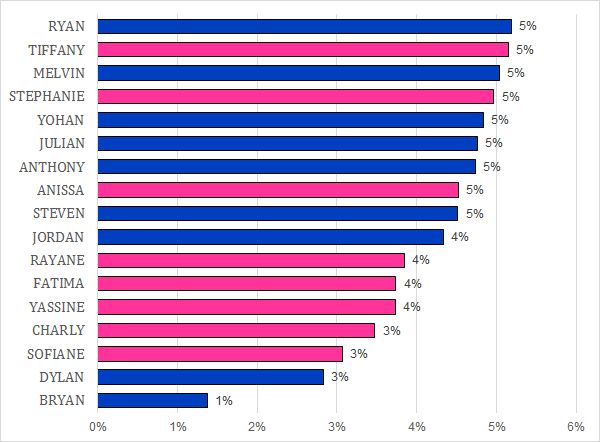
The baccalauréat exam taken by French students at the end of high school serves as qualification for university admissions and scholarships and for certain jobs. Those who pass at the highest level get très bien. The other levels are bièn, assez bièn, pass, and not pass. For some reason, the government publishes the results for each prénom. This year, 89 students named Jacques took the exam.  Of these, 75 passed, but only 11 of them at the très bien level.

Here are the results for the names with the highest percent of très bien. (Only names with 100 or more are included. Sixty-seven percent of those named Pavel, Louis-Raphael, and Hans got très bien, but there were only three of each.)

(Click on an image for a slightly larger view.)

And here are the names with the lowest proportion of très biens. 

All the high-scoring names are female. At the bottom, the gender distribution is more even. What you can’t see from this is that these results are remarkably similar to those of previous years. French sociologist Baptiste Coulmont has posted interactive name-cloud graphs for the data each year (here) – no doubt the graph for this year will be up soon. Below is a non-interactive screenshot of the 2015 results. The x-axis is the percent of très biens, the y-axis the number of students with each name (names with fewer than 200 candidats were excluded). You can find Diane and many of her high-scoring peers from 2016 on the right; Bryan, Tiffany, and the other slower students are on the left.

(For a slightly larger view, click on the image. Better yet, go to Coulmont's Website)

The year-to-year consistency is striking. In 2016, Diane was fourth highest in percent of très biens. Last year, she was #2, and in the years before that, #13, #2, and #9. Alice, Josephine, and Clotilde, were also in the top ten last year. At the other end, Jordan, Dylan, Bryan, Anissa, Anthony, and Steven all scored in the lowest ranks this year and last. And to state the obvious,  the 584 (of 601) Dylans who scored less below très bien this year cannot be the same Dylans as the 956 (of 982) who did so last year.

Social class has much to do with it. The children of the wealthy get educational advantages. They also get different names. Coulmont identifies some upscale names too infrequent to appear in his graphs but which typically  have high rates of très bien – Guillemette, Quitterie, Anne-Claire, Sibylle, Marguerite, Domitille. I confess that I am not familiar with the class subtleties of French names. I didn’t even know that Quitterie and Domitille were, in fact, names. And then there were those names familiar to my American ear –Kevin, Cindy, Sandra, Alison, Kelly, in addition to those already mentioned. Why are all the Anglo-name kids sitting in the low end of the scale?

One explanation is that these names are chosen by parents who watch American soap operas on French TV, parents not likely to be found in Bottin Mondain (roughly parallel to the Social Register). Possibly. But that doesn’t explain Kevin, a name that has not appeared on any soap. Maybe Angle names just have a middlebrow appeal in the same way that French imports like Michelle and Nicole came to enjoy great popularity in the US.

If only we had a breakdown by name of SAT scores, would it show any consistent patterns?.

Arrogant and Proud of It

July 7, 2016
Posted by Jay Livingston

Gersh Kuntzman in the New York Daily News (here) listens to “God Bless America” in yet one more seventh-inning stretch and argues that it’s time to take it out of the ball game.

The song still embodies great things about America, but also our worst things: self-righteousness, forced piety, earnest self-reverence, foam.

The song, says Kuntzman, offends: some believers; atheists of course; and the folks who think that baseball games should be about baseball. Also foreigners.

I once went to a Brooklyn Cyclones game with a British guy named James Silver, who smiled when “God Bless America” was being played. “It’s exactly what I expect from Americans,” he said. “The self-righteousness, the patriotism. It’s always nice to see my opinions confirmed.”

One comment from one foreigner at a Class A game* is not exactly persuasive evidence. But many others have voiced the same opinion, and conveniently, last week Pew published its report on “America’s International Image” (here). The Brit Brooklyn baseball observation seems to be the consensus.  When people are asked if they associate the word arrogant with Americans, the majority in most countries say “yes.” That includes Americans.


Intolerance is the flip side of arrogance. It’s not just that we Americans, blessed by God, believe that we are the best, but that those who differ from us are wrong.


Americans view themselves as tolerant, more so than do other countries except Poland (what’s up with Poland?). Clearly, people in those other countries are wrong. But where could they have gotten that idea? Maybe from politicians like Marco Rubio, who at the last Republican convention, said of proposals like Obamacare, “These are ideas that threaten to make America more like the rest of the world instead of making the rest of the world more like America.”

Or maybe they were thinking about the pronouncements, to great applause, of a more recent and more successful candidate for the office of president.

----------------
* For those not familiar with the baseball, Class A may sound good but is in fact fairly far down in the minor league hierarchy.

Producing Reality

July 5, 2016
Posted by Jay Livingston

At the end of the video about his famous prison experiment, Philip Zimbardo says, “Our behavior is much more under the control of situational forces and much less under the control of things like character and personality traits.” If you’re looking for a good example of what he means, try at least the first few episodes of  “UnREAL” on Lifetime.  The show is fictional, a behind-the-scenes look at a reality show called “Everlasting,” its fictional version of  the reality show “The Bachelor.” Are you still with me? A fictional, or simulated, prison and a fictional TV show about a fictional TV show are telling us something important about reality – not reality-TV but real life, real reality. (And yes, I am aware of Nabokov’s dictum that reality is “one of those words which mean nothing without the quotes.”)

The creator of “UnREAL”, Sarah Gertrude Shapiro, worked on “The Bachelor” for three years, and   “UnREAL” is partly an exposé revealing how the producers of the show manipulate the girls (as the show usually calls them) into doing things that are good for the show’s ratings but disastrous for the contestants themselves. “Cash bonuses for nudity, 911 calls, catfights,” the “Everlasting” show-runner Quinn yells to her producers.

(Vocabulary note. The “producers” are the assistants whose job is to manipulate the contestants and the “suitor” into doing what’s good for the ratings. The person in charge of the show, its creator, is the “showrunner.” The word produce is used unironically as a synonym for manipulate. In one episode, when the Suitor was pursuing his own strategy, Quinn, the showrunner, tells Rachel, a producer, to get him back in line, saying something like, “You know what to do. Produce him.)

The producer who serves as Sarah Gertrude Shapiro’s alter ego is Rachel Goldberg. In the Season 1, Episode 1, we see her lying on the floor of a limousine full of beautiful, gowned contestants. She is out of camera range, wearing a t-shirt that says, “This is what a feminist looks like.” The t-shirt is frayed, threadbare, a relic from her student days at Vassar.


She’s a feminist, yet she knows that in the coming weeks, she and the other show staff will exploit these women psychologically and physically. They will make sure the girls get little sleep and much alcohol. They will tell them lies to bring about tears and fights. “The Suitor” is no place for female solidarity. As Shapiro put it in an interview, Rachel is like “a vegan working in a slaughterhouse.”

Shapiro says that her own morality suffered a similar conflict and quick erosion. Here’s a clip from that same interview.


(Here’s a transcript of the end of the clip.)

I went to Sarah Lawrence, and I remember some seminar where we were talking about what would it cost for you to torture another human being, and everybody was like, “twenty-five million dollars.” And I quickly discovered it was like fifteen hundred dollars a week without benefits was fine.

It’s not just the money. The show becomes its own world. The contestants are required to give up all contact with the outside world (no cellphones, no Internet) so that the staff can more easily manipulate their reality. For the staff too, 19-hour workdays leave little time for life off the set. So the world of the show, with its  overarching value on ratings, is their reality as well. Staff get not just money but admiration for producing heartbreak, catfights, and other drama. They also have contracts and career aspirations that make it difficult to walk away. And for the staff, there was the added attraction of power.

“What Would You Do?” asks ABC’s popular television show, which is basically a variation on a theme by “Candid Camera.” It contrives a situation, then sets the cameras running to catch the reactions of unwary people. What will they do when they see a bicycle thief in action, a rude barista, a drunken cab driver, a racist store clerk, etc.? We think that we are the kind of person who does the right thing even in the face of social pressure.

“What would you do?” The most accurate answer is , “I don’t know.” As we have learned from a half-century of social science experiments – the Milgram obedience experiments are the best known – we are not very good at predicting behavior in a novel situation. People wind up doing things that seem to go against their most cherished values. It happens in real life too, and the important difference from the the ABC show and the psychology lab is that real-life situations come with a longer history and a thicker context.

Of course, most of us do not spend our workdays trashing our moral principles. But is that a testament to our strong moral fiber? Or, as Zimbardo suggests, is it because the situations that life affords us do not push us in that direction.

Flashback Fourth

July 4, 2016
Posted by Jay Livingston

This is still my favorite Fourth of July photo.


I took it in 2008 in Lenox, Massachusetts and blogged (here) about liberals finally seizing the banner of patriotism.

Two years later, after I’d spent a day at Jones Beach, I posted this about Sarah Palin’s phrase “the real America,” which I summed up as “Norman Rockwell, but with guns and NASCAR.” She was confusing “real” with “ideal,” but maybe she had a point.
           
In 2012 (here) my Fourth of July post was again about patriotism and the flag. Or rather, flags. Specifically, it was about people who think of themselves as patriots yet nevertheless fly “the flag of a country that fought a war against the USA – a war that killed a greater proportion of the population of the USA than has any other war in our history.”


The Perils of Pure Democaracy

June 26, 2016
Posted by Jay Livingston

In yesterday’s post on the Brexit vote, I wondered aloud about the wisdom of using a referendum to decide on specific policies. A commenter characterized my views as “the quintessential liberal view – elitist, snobbish, dismissive of democracy.”

I had thought that my reservations about direct democracy were more on the conservative side, something along the lines of Edmund Burke (1729 - 1797), much beloved among American conservatives. (“In the twentieth century, he became widely regarded as the philosophical founder of modern conservatism.” Wikipedia) Burke was elitist and snobbish, and he favored decisions by elected representatives, not the masses, even when a representative’s decision contradicted the views of those who elected him. As Burke says to a hypothetical constituent of such a representative,  “Your representative owes you, not his industry only, but his judgment; and he betrays, instead of serving you, if he sacrifices it to your opinion.”

As for “elitist, snobbish, dismissive of democracy,” the phrase also describes another icon of American conservatism, William F. Buckley, Jr.

Hamilton and Madison also favored a republic, with laws made by representatives, rather than what Madison calls “pure democracy.” Federalist #10 emphasizes this idea, though more to thwart the tyranny of the majority than to provide a buffer against bad judgment. Madison has a point. Suppose that a majority of the members of a community, a university for example, want to prevent conservatives from giving talks on campus.

Pure democracy would give us stronger gun control (including an outright ban on assault weapons), much more government spending on infrastructure, higher taxes on the wealthy (especially on capital gains), Senate hearings and a vote on Supreme Court nominee Merrick Garland.

But would we really want public opinion to determine these matters? Would we want a referendum on whether we return to the gold standard? Nearly all economists say it’s a bad idea. But it sounds good. After all the gold standard is, well, the gold standard of economic policies. And if something is the gold standard, that means it’s the best in its category. It’s easy to imagine a majority of the people being convinced of its virtues.

Maybe the 2008 bank bailout is a better analogy to Brexit. The bailout was a controversial matter. Simply put, the government would be giving a ton of money to the people who tanked the economy. Still, most economists as well as the Wall Street elites, thought it was necessary. The quintessentially democratic, non-elitist way to decide the matter would have been a referendum.

In March of that year, a poll showed that 60% of Americans opposed a bailout.

Maybe a referendum wouldn’t have been such a great idea even though it may have seemed like on at the time.


A Good Idea at the Time

June 25, 2016
Posted by Jay Livingston


The pound was down 10% making anything imported to the UK more expensive. Global markets tumbled, including those in the UK. Some Leave supporters were ecstatic.


But some seemed to be having buyer’s remorse. Google searches for “What happens if we leave the EU?” and “What is the EU?” tripled. (WaPo) They seemed to be waking up the morning after wondering just what it was they had done the night before.

All I could think of was Steve McQueen’s famous line in “The Magnificent Seven.”  McQueen plays Vin, one of the seven gunslingers who come to the aid of Mexican peasants who are being constantly raided by a group of bandits led by Calvera. At one point, Calvera captures the seven. He cannot understand why they would sign on to help a bunch of Mexican peasants.

CALVERA: The thing I don’t understand is why a man like you took the job in the first place. . .  Tell me why.

VIN: Fella I once knew in El Paso, one day he took all his clothes off and jumped in a mess of cactus. I asked him the same question, why? He said it seemed to be a good idea at the time.*


The vote to leave appears to be one of those impulsive decisions, the ones that seem like a good idea at the time. Many Leave voters – at least the ones who got a few seconds of airtime on American radio – were thinking in terms of personal complaints, not national policy. They reminded me of the woman I rented a flat from in London a decade ago. “There’s no Brits in London any more,” she said. and she was not happy about it.  

Voting often has a strong emotional component. The advantage of representative democracy over direct democracy is that we give the job of turning sentiments into actual policy to our representatives. Presumably, they have to think through more of the implications.**

I suppose what a democracy needs is a mechanism that allows people to express their political emotions and have it appear that those emotions have become policy while at the same time leaving real policy to those who will craft it more slowly and soberly.

The Leave vote does not automatically change the UK’s position. As a Financial Times post explains, the vote is technically a non-binding advisory. It’s possible that parliament will decide to act against the advisory. In any case, the process of leaving will take two years, and perhaps during that period, UK voters may rethink the Brexit,*** even it seemed like a good idea at the time.

As Calvera says to Vin in that same scene, “Only a crazy man makes the same mistake twice.”

------------------------------------------

* The video clip is here . I didn’t embed it because the way McQueen delivers the line doesn’t capture the feeling I think is appropriate. He’s serious, almost somber. I would prefer him laugh it off and say in effect, “Yeah, I guess it was stupid, but what can you do?” I also think that “seemed like a good idea” sounds better than “seemed to be a good idea.”

** My knowledge of political thought is slender. But surely one or more of The Federalist Papers must have considered this problem – how to keep the passions of the majority from inflaming the process of running a government.


*** On Planet Money,” the American hosts asked British economist Tim Harford, Any chance for a do-over? Two out of three?” Said Harford, I think it’s unlikely.”

Blame Canada Culture

June 23, 2016
Posted by Jay Livingston

Culture as a concept has always fascinated me –all those different groups with their different ways of thinking and reacting. But I’ve also grown skeptical of culture as an explanation for things we don’t like – especially when the explanation invokes the general culture for a problem that is more specific.

Here, for example, is Ramesh Ponnuru writing earlier this month at Bloomberg

Trump’s success in the presidential race so far reflects a cultural rot: It would once have been impossible for someone like him to win the nomination. But it also deepens that rot. If we elevate a man we know to be cruel, impulsive, insecure, vain and dishonest to the most powerful position in our country, that choice helps to define our own character and shape our expectations for one another. It also means that our political debate will be dumber, nastier and more content-free.

Is our culture in fact rotten? Ponnuru offers no evidence that it’s any more rotten than it was in the past. Instead, he offers this circular logic.
  • Why is Trump winning in the primaries? Because of cultural rot.
  • How do you know there’s cultural rot? Because Trump is winning. 
The other problem is that Ponnuru is blaming the entire culture for the actions of the Trump voters and supporters. At least I think he is. In much of the article he talks about “conservatives” who support Trump. But when he says “if we elevate . ..” and “our own character,” he seems to be casting a wider net. By “we” Ponnuru might mean conservatives or Republicans, but he never mentions  “conservative culture” or “Republican culture,” so I get the sense he means American culture.

But cultures don’t vote; people do. So political scientists rarely talk about cultural rot. Instead, they ask who are these people who support Trump — what age, gender, race, region, economic position, policy views, etc. But if, like Ponnuru, you are a conservative* and a Republican, you probably don’t want to say that a lot of the people who have been voting for your side all these years are morally rotten. And you don’t want to blame your party for those voters’ rotten choices. Instead, you’re like the parent whose kid is arrested and who says, “He’s a good kid, he just got swept up by the wrong crowd.” So you take a “Blame Canada” strategy and say that all these Trump voters got swept up by the cultural rot that is at large in the US.

-------------------------------------

* Ponnuru focuses on another factor dear to conservatives – character. He cites JFK, Gingrich, and Bill Clinton for their infidelities. But supporting Trump is worse, he says, because “the public had no way of knowing about most of their vices before voting for them. (Nixon’s swearing on the Watergate tapes, while not the focus of public concern, was scandalous.)” Yes, that’s right. The worst character flaw Ponnuru can find in Nixon is his swearing.