Which Side of History Are You On?

May 10, 2012
Posted by Jay Livingston

In yesterday’s post (here) on the anti-gay-marriage vote in North Carolina , I said that the tide of history – short-run history at least – was flowing quickly the other way.  Here’s the evidence from the Pew survey. In each age cohort, the percent favoring gay marriage has increase substantially since 2009.

(Click on the chart for a larger, clearer view.)

The young, who will make up more and more of the electorate, are twice as likely as the old to favor gay marriage.  On top of that, acceptance of gay marriage has increased among all age groups. In twenty years, when the youngest of the silent generation who are still alive will be close to ninety, most of the population will look upon these anti-gay efforts the way we now look at those old anti-intermarriage laws – as, depending on your point of view, quaint, puzzling, ignorant, or vicious.

The Pew Website has more charts – animated and interactive - on this topic.

The Lilies of the Street

May 10, 2012
Posted by Jay Livingston

Felix Salmon (here) writes about using “neutrinos to transmit information, at the speed of light, right through the center of the earth.”  He continues:
If this was successfully implemented, price information from Sydney could reach New York in just 40.2 milliseconds, compared to the 84.4 milliseconds it takes to send that information on fibers around the surface of the earth. The difference is more than enough time for traders in New York to make real money arbitraging securities listed in both cities.
I don’t know enough about neutrinos, arbitrage, or Felix Salmon to be sure, but I think he’s being ironic. 

In 2009, we learned that Goldman Sachs was making untold millions by using computerized “high frequency” trading. 
Powerful algorithms — “algos,” in industry parlance — execute millions of orders a second and scan dozens of public and private marketplaces simultaneously. They can spot trends before other investors can blink, changing orders and strategies within milliseconds. (From the New York Times)
That year, Goldman paid its 30,000 employees year-end bonuses that averaged $700,000. That’s the average; many executives and traders took away millions

Those neutrino  arbitrageurs and derivative traders make up a fair chunk of the 1% (or really the half of one percent, according to Scott Winship)  They got rich and stayed rich by moving money around.  At warp speed. The Republicans tell us it would be disastrous and unfair to raise their tax rate from 37% to 39%, even though in reality, thanks to complicated tax laws, many of them pay a rate that’s half of what their office staff pay. Why disastrous and unfair?  Because they are “job creators.” 

Behold these job creators, the lilies of the Street. They manufacture not, they service not, they heal not, teach not, entertain not . . .  yet Solomon in all his glory never had the kind of moolah they have amassed. Goldman’s profits in 2009 were about $13 billion. 

Do we have an estimate of how many jobs they created? 

HT: Dan Hirschman

Tar Heels Do It Again

May 9, 2012
Posted by Jay Livingston

Is North Carolina once again lining up on the wrong side of history?

The citizens of North Carolina voted yesterday to prohibit gay marriage.  It wasn’t the first time North Carolina put marriage in its constitution.*


The text of 1875 constitution says that interracial marriages are “banned forever.”  Not quite. The ban lasted 92 years.  When North Carolina drafted a new constitution in 1971, the US Supreme Court had already declared state intermarriage laws unconstitutional. 

Will it take that long for the Court to take a similar view of laws banning same-sex marriage?  That depends on who appoints the justices.  But I suspect that public opinion will turn much sooner, even in North Carolina.  In 20-30 twenty years, most Americans will look at these laws the way we now look at those 19th-century anti-miscegenation statutes that survived until 1967 – with the binge-drinker’s  morning-after sense of embarrassment.  “Did I really do those things?” – as though the denial of rights to whole categories of people had been unintentional, not really harmful, and in retrospect maybe even kind of amusing. 

--------------------
* I found this image at the Think Progress page on Twitter (here).  It can surely now be found in many other places.

Sendak and Childhood

May 9, 2012
Posted by Jay Livingston

All happy childhoods are alike.  Each happy childhood is unhappy in its own way.  Or maybe not.  But just as people differ in how they view their own childhoods, cultures too vary in their dominant image of childhood. 

I’ve posted before (here for example) that in American movies children are often morally superior to adults – wiser, more competent, and more honest.  They are also untainted by the complexities and troubles of the adult world. 

That’s not the way Maurice Sendak saw it.  Those monsters in Where the Wild Things Are were based on his own aunts and uncles. 

In 1993, Art Spiegelman visited Sendak “at his idyllic Connecticut estate” and drew the experience for The New Yorker.


Sendak and Spiegelman both work in the panel format. Both are children of Polish Jews and have family who were killed in the holocaust.  It’s possible that they also share an almost un-American view of childhood. 

(This probably violates the New Yorker copyright, but until they come for me, I’ll leave it up. You can see the full Spiegelman story here.)

Choosing Junk

May 8, 2012
Posted by Jay Livingston

Some people, many people in fact, prefer junk food. They buy it even when the food labels and the fast food outlets post the caloric counts and ingredients that tell them it’s junk 

If you assume that Google’s auto-complete reflects volume, many people also prefer junk news and information.
 
Andrew Gelman  links to this article comparing our media diet to junk food.  Here’s a screen shot of an excerpt, but the whole thing is worth reading.


Angry Birdbrains

May 7, 2012
Posted by Jay Livingston

If you don’t like the way the majority votes, it’s always tempting to attribute their behavior to ignorance, emotion, or some other nonrational or inferior mental state.  

Here is this morning’s Wall Street Journal headline about the election in France:

Voter Anger Sweeps Europe

Most newspapers headlines reported the French election as a matter of policy.  The voters rejected economic policies of austerity – not so illogical, since there was little evidence that those policies were working.  But the headline writers at the WSJ saw the French majority as letting their emotions get the best of them.  The WSJ story reports only on France, but the headline sees all of Europe as caught up in this contagious emotion. 

Voters do sometimes share emotions.  Hope and optimism characterized a segment of Obama voters in 2008, and there was probably systematic evidence for that description.  Two years later, the Tea Partiers were often angry (they still are).

Anger might have been the principle motive yesterday in France, but the WSJ story offers only two bits of evidence:
  • 20% voted for far-right candidate Marine LePen two weeks ago in the premier tour
  • only 81% of the electorate actually went to the polls
The WSJ writers assume that those they disagree with (LePen backers) must be voting their emotions.  The same goes for “center-right” voters who voted for Hollande.  According to the WSJ story, they were “angered by [Sarkozy's] swing to the far right.

Ah, what to do about those irrational voters?  In 1970, when Chileans democratically elected Salvador Allende, US Secretary of State Henry Kissinger said, in a now famous quote, “I see no reason why we should allow a country to go Communist just because of the irresponsibility of its citizens.”

Unlike Kissinger, the WSJ is not underwriting a coup against the Socialists.  Not yet.

Fashion, Food, and Drink

May 5, 2012
Posted by Jay Livingston

Sometimes the tide of fashion flows uphill. 

I heard Ruth Reichl speak at “Foodstock,” a mini-conference at Wesleyan University.  The interviewer, Faith Middleton,  asked her if food was subject to fashion.  Absolutely, said Reichl, and the fashions are always related to class.  Reichl is a wonderful food writer and editor, and I assume she knows her food social history.  The example she gave was from ancient Rome. 

After the onstage interview was over, I asked her if fashions in food, like those in clothing and names,* diffuse downward through the class system. 

Yes, she said, but sometimes it goes the other way.  Right now, chefs in high-end restaurants are drawing inspiration from the ethnic food trucks that have sprung up in the last few years.  She added that a similar trend sometimes happens with clothing – a street fashion gets picked up by trendy designers, who tweak it slightly and send it onto the runways, though with a price tag that would make the original wearers gasp. 

Right, I thought – blue jeans.  These had always been cheap and durable – qualities that made them ideal as work clothes for people who labored outdoors, or play clothes for kids.   Then in the 1970s, Gloria Vanderbilt, Calvin Klein, and others reached down through the class strata, hauled them up, tightened the fit, and gave us “designer jeans.”

Another example might be beer, long an ordinary, working-class sort of drink with little cachet.  But now we have “designer beers” – more expensive “craft beers” from micro-breweries, ales and lagers that allow sophisticated people to show off their discernment.

I mentioned this idea to Eric Asimov, the New York Times wine critic, as we stood in line at the Ethiopian food truck.  “Is there any equivalent in wine?” I asked. 

Maybe in France, he said.  The big name wine houses will buy a vineyard or wine from a region not known for “great” wines.  So you’ll see the more ordinary wine, carignan for example, but under the a more famous label. 

I doubt that these regional wines would be considered to be “better” that the Bordeaux and Burgundies.   But in their own way, they might become more fashionable

---------------
* (Update to the previous post).  In 2010, Isabella was among the top five names in all but two states (Idaho and Utah), but just eight years earlier, only seven states accorded her that place – Massachusetts, New York, New Jersey, Colorado, Florida, and Rhode Island.  In naming their daughters Isabella, states like Arkansas, Kentucky and Wyoming are Jacob-come-latelys.
I would guess that even within those vanguard states, the 2002 Isabellas were born to  more educated and wealthier parents.  Fashions in clothing follow a similar path.  By the time a style shows up in Target, the people who first bought it are looking for something else.

Twilight Timing

May 3, 2012
Posted by Jay Livingston
Cross posted at Sociological Images

Jacob and Isabella were the most popular baby names last year.  Some observers, even some sociologists, see this as the influence of “Twilight.”  (See here for example.) 
But Jacob, Isabella, and even Bella were on the rise well before Stephanie Meyer sent her similarly-named characters out to capture the hearts ,minds and naming preferences of romantic adolescents. 


(Click on the graph for a larger view)
The forecasters predict a bumper crop soon in Rue, Cato, and perhaps other names that are from Hunger.  Still, since the YA audience for these books and movies are more Y than A, I’m hoping for lag time of at least a few years before they start naming babies.  As I blogged earlier (here) “Splash,” the film with Darryl Hannah as Madison the mermaid, came out in 1984, but it was not until nine years later that Madison surfaced in the top 100 names. And if there’s a Hogwarts effect, we’re still waiting to see it.  The trend in Harry and Harold is downward on both sides of the Atlantic, and Hermione has yet to break into the top 1000.

Don’t look for any Katnisses to be showing up on your class lists for quite a while.

Game Theory – It Takes Balls

April 30, 2012
Posted by Jay Livingston
Cross posted at Sociological Images

I don’t know much about game theory.  I’ve always found it hard to squeeze real-life situations into the shape of a prisoner’s-dilemma matrix and to think of life as a game.  A game show, on the other hand, is a game.  And the final round of the British show “Golden Balls” is totally Prisoner’s Dilemma.  (Shouldn’t that apostrophe be moved to make it be Prisoners’ Dilemma? After all, it’s not solitaire.)

You can get the idea of the set-up in the first two minutes of this clip.*  But don’t stop there.  Watch the full six minutes, and appreciate the ingenuity of the strategy played by Nick (he’s the guy in the brown shirt on the right of the screen).


SPOILER SPACE, which I’ll fill with the “Golden Balls” matrix.


In many prisoner’s dilemma scenarios, the prisoners are separated and can’t discuss their options.  In “Golden Balls,” they can talk things over, the only catch being that each player is well aware that the other might be lying.  Earlier rounds of the game are designed to encourage lying. 

Nick is ingenious in two ways.  First, he brings in an option that “Golden Balls” does not include but cannot exclude: the offer to split the loot 50-50 after the show even if the show gives the entire amount to him.

Second (and here is where my lame game-theory knowledge is showing), by convincingly maintaining that he is going to Steal, he destroys the Nash equilibrium that “Golden Balls” tries to create.  He forces Ibraham to choose Split, for Ibraham’s position n ow becomes this:
  • If Nick is fully telling the truth about sharing: Split, I get £6500. Steal, I  get 0
  • If Nick is lying about sharing: Split, I get 0.  Steal, I get 0.
  • So my only hope of getting anything is Split.  
Which is what he does. 

Nick’s ploy also creates an interesting dramatic switcheroo for the viewers as well.  As we watch the clip, it looks as though all the pressure is on Ibraham.  We can see him debating with himself and with Nick.  But after the two men show their balls, we realize that in reality, it’s Nick who had to be sweating, not about which choice he will make – he has already decided that – but about whether he is actually fooling  Ibraham.  He was betting £13,000 on his own acting ability.  That takes balls.

One other observation: I used to watch “Survivor,” and when players would lie and succeed, I might have admired them for being the clever strategist, but I didn’t like them.  In fact, I often actively disliked them.  But here, when I found that Nick had lied successfully, I was hoping that Ibraham or “Golden Balls” would give him a few extra pounds as a bonus.

--------------------
* The clip is from February.  I found it thanks to  Planet Money, which posted it last week without comment.

Weed Arrests Are Not About Weed*

April 29, 2012
Posted by Jay Livingston

Arrest data for some crimes rise or fall with the amount of that crime.  If you see arrests for homicide increasing, you can be fairly sure that homicide itself is on the increase.  By contrast, an increase in arrests for prostitution is almost certainly the sign of a “crackdown.”  A higher level official – the precinct commander, the police brass, maybe even the mayor – has told the cops on the street to arrest more hookers. 

Neither of these explanations accounts for the trend in marijuana arrests in New York, particularly in the Bronx.  On Sept. 19, 2011, Ray Kelly, the NYPD commissioner, issued an order that police should not arrest people for possession of small amounts of marijuana, the personal-use weed that cops found in stop-and-frisks. 

The Guardian has published some graphs (here) showing the numbers of marijuana arrests in 2011 and in the previous three years.  These usually decline in the fall – cooler weather, back-to-school – and the Kelly edict should have steepened the slope.  But that’s not what happened.

(Click on the chart for a larger view.)

Keith Humphreys at The Reality-Based Community notes that marijuana arrests are often “substitute arrests.”  Just as a substitute drug is what you use when you can’t get the drug you want, a substitute arrest is one cops make when they can’t arrest the person for the crime they’d like to bust him for.   The cops might be doing whatever they can to punish someone witnesses might not want to testify against – a high-level drug dealer, a frequent wife-beater, or even a robber. Or the cops might be using stop-and-frisk marijuana arrests to get troublemakers off the street, at least temporarily, in order to maintain order.  Or they may be using the arrest to assert their authority (or from the arrestees’ perspective, throwing their weight around by hassling kids). 

“Substitution arrest” may be good explanation for why police bother to make these one-joint arrests.  But it does not account for the increase in such arrests following an order from the top to stop doing it.

I’m puzzled.


----------------------------
*The title of this post is derived from one of Robin Hanson’s favorite constructions   I’ve used it before (here), and I’ll probably use it again.

We Want to Have Our Appendix Out Too

April 26, 2012
Posted by Jay Livingston

How compatible are medical care and the free market?

The SocioBlog’s most viewed post (it got Boinged) showed widely varying prices among countries for the same medical products (hospital stay, Lipitor, OB delivery, office visit).  The US prices were four to ten times higher. 

Within the US, even within the same county, prices also vary widely.  Sarah Kiff at WaPo’s Wonkblog reports (here) on a study in the Archives of Internal Medicine (gated, here) that compared prices for an appendectomy.  The range: $1,500 to $187,000.  It’s as though the price of haircut ranged from $15 to $1870.   Even in the county with the least variation, the difference between the least and most expensive was $46,000.

It’s essentially the same service, though one haircut or appendectomy might be much better than another.  But not that much better.  These prices suggest that the usual market processes are not in play.  And they are not.  When I get a haircut, I pay the barber, and I check the price list before I go into the shop.  If my haircut insurance company were paying, I’d just walk in.

Also, unlike an appendectomy, my haircut is not an urgent production.  My untrimmed hair is not causing me to double over in intense pain, desperate for relief.  Even if I don’t act quickly, I won’t die.  I can take my time to shop around.  I can ask friends for suggestions, I can look for online reviews, and afterwards, I can form a reasonable opinion of the barber’s competence.  I’ve never had appendicitis, and unlike Miss Clavel's charges, I’m not eager for it.  But if my appendix were to start acting up, I’m sure I would not be a Consumer Reports type of consumer. 
 
The market is supposed to bring us more and better goods and services at a lower price.  With healthcare in the US, both the process and the outcomes suggest that this is not the ideal example of a market.

My Lunch With Charles

April 25, 2012
Posted by Jay Livingston

Charles Murray is the first author Nicholas Lemann discusses in his New Yorker piece (here) on inequality.  Murray’s recent book Coming Apart documents the moral decline of the white working class, and while Lemann doesn’t dispute Murray’s data, he is puzzled by Murray’s choice of villains – the liberal elite. They may live exemplary lives – work, family, religion –
But, unlike the elite of Victorian England, they don’t “preach what they practice.”  Somehow, this manifests itself in the breakdown of social more at the opposite end of society.

The elites, in Murray’s view, devote their free time to their own obsessions and diversions – exotic foods, chic wines, hybrid cars, and the like – when they should be driving their pickups to Applebee’s to talk about Nascar and the latest episode of “American Idol” with people who barely finished high school.  And somewhere along the way, maybe as everyone is lighting up a cigarette, they’ll slip in a few words about the benefits of a virtuous life.*

I’m sure that Murray, sitting at a table with people who voiced prejudiced, ethnic stereotypes would be quick to remind them that prejudice was not only nasty but economically unwise, since it excludes the capable and virtuous, and that trust, even of those outside our little tribe, is an important source of America’s success.

Several weeks ago, Edward Luce reported in the Financial Times on his lunch with Murray.  Here are some excerpts:  (The full article is here. )
Our venue is Al Tiramisu, a well-hidden Italian restaurant close to Dupont Circle . . . .

He is buoyed when the waiter says the black-truffle pasta is still on the menu, and we both order it as a starter. I have already said he must have a glass of wine. “Now, does the FT extend to a bottle?” Murray asks as he leafs through the wine list.

Our black truffle has arrived. Murray’s martini glass is empty. The waiter pours him a taster from the bottle of Gavi di Gavi, an Italian white wine. “Mmmm, it’s like a good Montrachet,” . . . I ask him what kind of wine a Gavi di Gavi is. Murray discloses that it is a “varietal”. I nod as though I know what that means. It certainly tastes nice. “Varietal means expensive,” he adds.
So much for Applebee’s and a Bud Light.

He discloses that he sometimes plays poker at a casino in Charles Town, West Virginia, and that he will, in fact, head over there after our lunch has finished. “The ways in which it reinvigorates your confidence in America is really interesting,” Murray says.

“I remember sitting at a table a couple of months ago. And at a poker table there’s lots of camaraderie. And so here I am at a typical table at Charles Town. Big guys with lots of tattoos, sleeveless T-shirts, one of them an accountant, the other looks like he comes from a gang. There was an Iranian-American and Afghan-American. Incredible polyglot mix of people – all speak perfect idiomatic English – and the conversation turned to the fact that my daughter was going to marry an Italian. ‘Well, do you trust him?’ they said. ‘You know, you can’t trust those Italians.’”

Murray guffaws at the recollection. “The thing is, it was such an American conversation.”

For what it’s worth, Luce includes the tab:
  • Black truffle pasta x2 $90.00
  • Sardines $15.00
  • Barramundi $28.00
  • Gin martini $14.00
  • La Scolca Gavi di Gavi $105.00
  • Cappuccino $4.50
  • Double espresso $7.00
  • Total (including tax) $289.50
-----------------
* These emblems are taken largely from Murray’s “How Thick Is Your Bubble” quiz in Chapter 4 of Coming Apart.  You can find all 25 items here.

Methodology in the News

April 20, 2012
Posted by Jay Livingston

1. “Survey Research Can Save Your Life,” says Joshua Tucker at the Monkey Cage. He links to this NBC news story about a woman who went into diabetic shock while on the phone with a student pollster working for Marist.  He sensed something was wrong and told his supervisor.  She spoke to the woman and then called 911.  (The news story does not identify the student working the phone survey, only the supervisor.  Nor does it say whether the woman approved or disapproved of Mayor Bloomberg.)

2.  The New York Times this week reported on a RAND study that found no relation between obesity and “food deserts.”  The study used a large national sample; it’s undoubtedly comprehensive.  The problem is that if you are using a national sample of schools or supermarkets or stores or whatever,  two units that fall into the same category on your coding sheet might look vastly different if you went there and looked at them from close range. 

Peter Moskos at Cop in the Hood took a closer look at the RAND study, reported in the Times, RAND relied on a pre-existing classification of businesses. The prefix code 445 indicates  a grocery store. Peter, an ethnographer at heart, has his doubts:
New York is filled with bodega “grocery stores” (probably coded 445120) that don't sell groceries. You think this matters? It does. And the study even acknowledges as much, before simply plowing on like it doesn't. A cigarette and lottery seller behind bullet-proof glass is not a purveyor of fine foodstuffs, and if your data doesn't make that distinction, you need to do more than list it as a “limitation.” You need to stop and start over.
3.  NPR’s “Morning Edition” had a story (here) on death penalty research, specifically on the question of deterrence.  A National Research Council panel headed by Daniel Nagin of Carnegie Mellon University reviewed all the studies and concluded that they were inconclusive, mostly for methodological reasons.  For example, most deterrence studies looked at the death penalty in isolation rather than comparing it with other specified punishments. 

Another methodological problem not mentioned in the brief NPR story is that the number of executions may be too small to provide meaningful findings.  For that we’d need a much larger number of cases.  So this is one time when, at least if you are pro-life, an inadequate sample size isn’t all bad.

New York Education – Gifted, Talented, and Crazy

April 14, 2012
Posted by Jay Livingston

Individual facts may be very useful for explaining other individual facts. But in explaining social facts, they don’t always get us very far. This Durkheimian notion is one of  the first ideas I try to convey in my course (the first in our sequence of core courses for majors). 

Newspaper stories sometimes provide good bad examples. The New York papers today report on the results of the Gifted-and-Talented tests for public schools. Times recently ran a story with this headline:
After Number of Gifted Soars,
a Fight for Kindergarten Slots
Most of the article is about test prep for tots. It quotes Robin Aronow, former PS 9 parent, now an “admissions consultant”
[test prep] certainly seems to be having an influence.  There are more and more people who are putting their kids through some sort of test preparation, whether it’s buying the materials or using the test-prep companies . . .  I think the nursery schools have begun to integrate some of the materials into their classes as well.
No doubt, the trend is real.  Here are the numbers.


It’s possible that shelling out $150 an hour or more for test prep might improve your kid’s chances of making the G&T cutoff.  But these individual facts do not explain the doubling of numbers and percents shown in the graph.  If there’s any connection, the causal arrow will point the other way: increases in G&T qualifiers causes parents to buy test prep for their kids.    

What is driving the increase if not better test prep?  My guess is economic history. The recession has changed the population of test-taking tots; it now includes more kids from well-educated, better-off families. These parents, who once might have sent their kids to private school, have been discovering the virtues of public education, especially if they do the math and realize that over the K-12 span, that $40,000 a year adds up to a half million.  A demographic trend the Times story mentions – more families staying in the city rather than moving to the suburbs – contributes to the same effect.

When my son took the test for New York high schools, I commented to the dad of another test-taker that 27,000 kids were taking the test that day. He was unfazed by the apparent odds. “Twenty-five thousand – background noise,” he said.

That ratio of real competition to background noise has shifted, especially for kindergarten hopefuls, thanks to those economic and demographic changes. As a result, according to a test prep company founder, “the idea of preparing for the kindergarten test is totally the norm.”

If you don’t live in New York City, you may look at these norms – $150-an-hour test-prep courses for a four-year-old – and think, “Are these people crazy?”  I thought that way myself once.  I grew up in a Pittsburgh suburb (pop. 40,000). For K-6, kids went (usually on foot) to the local elementary school. There were two junior high schools (you went to the closer one) and one high school. No choice, no questions asked. Not until it was time for college did we survey our choices, visit schools, send off applications, take standardized tests, and go for interviews. In New York, middle-class families do all that for kindergarten and even pre-school. And many do it again for middle school and again for high school.  

I thought it was crazy, but still I did it.  My kid  was four.  “This is crazy,” I said to the test-giver, a psychologist, “scores for kids this age aren’t stable or predictive.”  She nodded.  Welcome to education in New York city.  

white on White

April 10, 2012
Posted by Jay Livingston

“Black is not a color,” says Philip Cohen in a blog post  explaining why he has decided to use upper case when writing about Black and White as racial categories. I agree. The title of that post is a tad coy. A more straightforward title might be, “black is a color, Black is a race.”  (I think the style manual still says to use italics when you refer to a word as a word.) 

It’s a small change, upper case for lower case, but it might move us one step away from the frequent conflating of the racial and the chromatic.

My favorite example of this color/race tangle happened here at Montclair.  A few years ago, the University became home to the work of artist George Segal, famous for his life-size, white-patina-on-bronze sculptures.  Montclair has, as our Web page boasts, “the only George Segal art gallery in the world.”  It’s housed in the most important building on campus, the parking garage.  Close by is this 1992 Segal sculpture “Street Crossing,” which came to the University in 2006 when the gallery opened.  (It has had two or three different placements.)


The Public Art Fund describes it this way:
Caught in an ambiguous psychological terrain, the seven figures seem blind to one another and to their surroundings. Segal had a particular ability to elevate mundane day-to-day activities into a lyrical or elegiac display, depicting his subjects with their guard down and in a naturalistic stance.
Maybe so.  But shortly after the sculpture was installed, a non-faculty employee here wrote to the president of the university from a different critical perspective.  The letter said, in effect, “This university prides itself on its efforts for diversity.  And then the biggest deal on campus is this sculpture of nothing but white people.”

The president wrote back explaining that the sculpture was a work of art blah, blah, blah.  And perhaps the employee was mollified.

But the problem here is not Art appreciation; the problem is not even race and diversity.  The problem is language. We need two words where we have only one.  Here’s another photo of the Segal piece.


After I heard the president tell this story, I asked our undergraduate assistant Heather to let me photograph her standing next to one of the figures in the sculpture.  Heather is, undoubtedly, a white girl.  She has very fair skin. Compared with her, I look positively swarthy. (Heather is also very good looking, and this photo, taken in strong sunlight – terrible light for photography – and unretouched, does her a real disservice.) Her skin is not the color of the Segal figure.

Still, we seem to be stuck with the same word, white, for both Heather and for the figures in the sculpture. But they are obviously not the same. No White person, even the palest and fairest, is that shade of white. If the word for White as a race were different from the word for white as a color, the offended employee might never have found cause to complain.  She would not have seen the sculpture as a bunch of “White people.”  

Do we have such a word?  Caucasian might do – you couldn’t say that the Segal figures were Caucasian – but the term is too long, and it implies a geographical link to the Caucasus that most White people don’t share. Besides, it’s part of a typology which has gone out of fashion in this country.

So at least for now, the only way I have to make the color/race distinction is with the shift key.

Is This Racist?

April 8, 2012
Posted by Jay Livingston
“The Haves and the Have Nots” said the marquee on the Beacon Theater.  I thought maybe it was a rock group, you know, like The Mamas and the Papas. 

We met our friends – a couple and their kids age 14, 17, and 23 – at a restaurant just around the corner.  I asked the three teenagers if they’d ever heard of such a group.  No.

It was early, 5:30, and there were only a few other diners in the place, mostly middle-aged African Americans.  Then it dawned on me – pre-theater dinner.  “I wonder if it's one of those Tyler Perry plays,” I said. 

My wife shot me a look and a very brief sentence, both of which meant, “Shut up.   You'll probably say something offensive and loud enough to be heard by these people at the table behind us.”

I knew that she was afraid I'd use the term chitlin circuit.  And maybe I would have.  I’d used it before.  In public.  But dammit, Skip Gates used the term in the New Yorker in a wonderful article about this genre of drama.  If he can, why can’t I? Or is chitlin circuit* one of those terms like the N-word that can be used only by the in-group?  What other words have this OK-for-us-not-for-you quality?

When I got home I Googled “The Haves,” and indeed it is a Tyler Perry play.  I reread the Gates article, written in 1997, before Perry became so successful.  It holds up.

I’m thinking of buying a ticket and going.  John Darbyshire, the National Review writer, would tell me that I’m risking life and limb.  Now that’s racist (his rant is here, but don’t say I didn’t trigger-warn you).

----------------
*  Wikipedia says that “chitlin circuit” is “now also known as the ‘urban theater circuit.’”

Reporting Numbers Truthfully

April 7, 2012
Posted by Jay Livingston

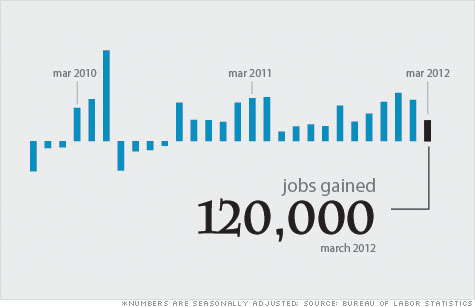
We have a hard time understanding or accepting indeterminacy.  We want our economic reports to have the same finality as sports scores.  The Rays beat the Yanks yesterday 7-6, and Carlos Peña’s grand slam and ninth-inning single had a lot to do with that outcome.  We want the same kind of precision of results and explanations in economic news – for example, yesterday’s jobs report – so  that’s  what the media give us.

Here, for example, is what CNN Money said.

March jobs report: Hiring slows, Unemployment falls

April 6, 2012: 2:47 PM ET

American employers hired 120,000 workers in March -- half of the job gains seen in February.

American employers hired 120,000 workers in March -- half of the job gains seen in February.
NEW YORK (CNNMoney) -- Hiring slowed dramatically in March, clouding optimism about the strength of the recovery.

Employers added 120,000 jobs in the month, the Labor Department reported Friday, falling far short of economists' expectations.

Meanwhile, the unemployment rate fell to 8.2% as the labor force shrank by 164,000 workers, mostly due to white women leaving the job market.
Economists attributed part of the hiring slowdown to an unseasonably warm winter that boosted job growth in January and February [blah, blah, blah . . . ]

 But economic numbers are sports scores.  R.A. at The Economist* rewrites the story:
  There is a 90% chance that employment rose by between 20,000 and 220,000 jobs. The change in the number of unemployed from February to March was probably between (roughly) -400,000 and 150,000, and there's a good chance that the unemployment rate is between 8.1% and 8.5%. Reported changes for important subsectors are too small relative to the margin of error to be worth discussing. In all probability, the employment growth has remained close to the recent trend of a 200,000 jobs per month increase.
--------------
*The Economist, for some reason, insists on initials rather than names in its by-lines.

Injuries and Incentives - Saints and Sinners

April 6, 2012
Posted by Jay Livingston

Did the bounty system work?

Even people with no interest in sports have heard about the strategy of Saints defensive coordinator Gregg Williams.  He offered his players a bounty for injuring opposing players – $1000 if a player was carried off the field, $1500 if the player didn’t return to the game that day.

On the audio released yesterday (listen here), you can hear Williams giving pep-talk instructions to to the defense just before the playoff game against the 49ers.  He specifies the injuries he would particularly welcome – a blow to the chin for quarterback Alex Smith, a concussion for receiver Kyle Williams, and as for receiver Michael Crabtree, “He becomes human when we fuckin’ take out that outside ACL.”

Much of the reaction to this story is shock and horror – some of it real, no doubt, by people unaware of football’s backstage, and some of it affected.  Among the players, there is anger and genuine surprise.  (“One word WOW,” tweeted 49rs safety Reginald Smith.)  Others were more sanguine, saying in effect, that football is a violent game where people get injured.  Jets linebacker Bart Scott said that getting rid of the bounties wouldn’t change that. 

But so far I have seen no data on whether the bounties worked.  Did the Saints injure more players than did other NFL teams?  Surely those numbers are available. 

The only evidence I’ve heard is that the Saints had the highest number of roughing-the-passer penalties in the NFL.  That’s probably because they blitz more.  Blitzing is a high-risk strategy, and there’s some question as to whether it’s effective.  In theory, blitzes should increase the defense’s chances of injuring the quarterback.  But the Saints were below the NFL median in sacks. 

None of that speaks directly to the question of injuries.  The bounty system is a recent and distasteful example of “incentivizing” (a recent and distasteful coinage among economists).  Has no sports economist or Freakonmist even counted up the injuries let alone run econometric statistics to see if these incentives worked?

The Jewish Vote, Abortion, and Status Politics

April 4, 2012
Posted by Jay Livingston

The “Jewish vote” came up on Fresh Air yesterday.  The interviewee was Peter Beinart (for the audio and transcript go here), and most of the interview was about Israel, specifically his proposal that Americans boycott products from West Bank settlements. 

Towards the end of the interview though, Beinart said that despite the controversy over his proposal, and despite politicians’ ringing statements of stout support for the Jewish state, Israel was not much of a factor in the Jewish vote.  But if not Israel, then what?
The single biggest driver of the Jewish vote in America is actually abortion.*
On the surface, this makes no sense.  Does the Talmud or any of the commentaries tell us that abortion is a mitzvah?  Does abortion directly affect the lives of many Jews – either as doctors or as patients?  I doubt it.  Instead, at least for American Jews, abortion is a matter of status politics.  Its symbolism far outweighs its practical consequences.

Issues inflated with the air of status politics are important because they signal the relative status of different groups.  These are the issues that usually get classified as “values” issues, a matter of morality.  But the important question is “whose values, whose morality?” because the answer to that question is also the answer to the question, “Whose country is this anyway?” 

My guess is that to American Jews, abortion looks like the flagship of conservative Christianity, with its assertion that America is a Christian country and should be run on principles of Christianity.  Beinart is more circumspect.  He frames the issue as “religious / secular” rather than “Christian / Jewish.”
American Jews are very strongly committed to an agenda of cultural tolerance, probably, in fact, because they're actually very secular. American Jews are much more secular than are American Christians
Maybe so.  Either way, it’s status politics.  It’s about which group – its customs, its morality, its symbols – will be honored as dominant.  So when politicians (invariably Christian politicians) rail against abortion, what Jews hear them saying is “This land is our land, this land’s not your land.”  

(Previous posts on status politics are here and here.)

 ----------------------
* I haven’t checked the data, but Beinart sounded as though he’d done his homework on this one.

UPDATE:  PRRI yesterday released a survey of 1,000 Jewish adults (pdf is here).  The main issue, by a mile, for the 2012 election was the economy.  Israel, as Beinart said, was a minor concern.  But abortion ranked even lower.
Other issues that fall at the bottom of the priority list are national security (4%), Israel (4%), Iran (2%), the environment (1%), immigration (1%), same-sex marriage (1%), and abortion (1%).
Beinart was necessarily basing his statement on earlier surveys. Possibly, when the economy was not so clearly the big issue, the status politics issues were more important.  

The PRRI survey makes clear that Jews are liberals, not conservatives.  One minor factoid.  One question asked how well each of several public figures represents Jewish values.”  Leading all others in the not at all well” category was Eric Cantor with 35% saying he was a poor representative of Jewish values.  The figure was significantly higher than Sarah Silverman’s 26%. 

Handling the Truth

April 3, 2012
Posted by Jay Livingston

We can’t handle the truth.  We want all the facts to fit with our picture of the world.

The “Mad Men” scripts (see last weeks post ) use words and constructions unknown to real 1966 ad men.   These anachronisms sound “right” to us despite their historical inaccuracy.   And historical facts may sound wrong. 

The Times TV critic saw the “Mad Men” season opener and complained:
The themes of civil rights and equal opportunity thudded into view in a couple of unfortunately ham-handed scenes, one involving the scamps at Young & Rubicam dropping water bombs on picketers (“And they call us savages!” an indignant protester exclaimed) . . .

Bad scene, bad line.  “It’s a terrible line that should have been red-penciled,” said the New York Magazine critic.”  The only trouble is that it’s all taken directly from a 1966 news item in the New York Times.


(This is a screen grab.  To see the full 1966 Times story – and if you saw 
the episode of “Mad Men” you must read it – go here. )

Far from being disarmed by the facts, the critics stood their ground when informed of the historical accuracy.  The Times critic still insisted that the scene was bad and that the line, a true quote, “just rings so false.”

The critics are right, of course.  All the news that’s fit to print does not make for good drama.  A scriptwriter or novelist has to select and shape the facts and edit the language.  What fictional people do and say must not clash with character. 

This preference for a coherent story, a perfect congruence of character and action, becomes a problem when we use it to filter reality and then think that this filtered reality is “the truth.”  But that’s another story.