March 4, 2008
Posted by Jay Livingston
Old joke: A turtle mugs a snail. The police finally arrive and ask the snail about the crime. “I don't know,” says the snail, “It all happened so fast.”
I missed this post by Jessica at Scatterplot last week. Two hundred people (is it really that many?) go to Grand Central Station and all freeze in place at the same time for five minutes. Jessica sees it as a large-scale “breaching experiment.”
Me, I’m not so big on breaching experiments (“Let’s do some weird shit and see how people react,”). I don't find it ennobling to think that the chief intellectual forebear of social psychology is Allen Funt. And as with Candid Camera, I usually find the gag itself more interesting than the reactions of the naive victims. So to my eye, the Grand Central video is worth watching not so much as sociology and more as art (broadly defined). Which is what its creators – Improv Everywhere – intended.
Here’s another of their gags – Slo-Mo at Home Depot. They do the freeze thing here too, but pay attention to the slow motion early in this excerpt.
Getting back to the turtle and snail. The video is really a demonstration of relativity. Look at this speeded-up version of some of the early scenes.
The Improv Everywhere “agents” who were in slo-mo now look like they are going at a normal pace, and the regular customers are running around frantically.
Everything is relative.
You can find a full account and more video at the Imrprov Everywhere site.


The Art of Imprisonment
March 2, 2008
Posted by Jay Livingston
When it comes to putting people in prison, we’re number one. We lock ’em up at a rate five to ten times that of other industrialized democracies (France, UK, Australia, etc.). We've been number one for decades, but the proportion of the US adult population in jail or prison has now risen to one in 100. That’s the finding published in the new Pew report . And Chris Uggen, who knows about such things, says that the 1% figure is an undercount.
Here’s a graph based on BJS figures.

Only a few days earlier – one of those coincidences of the Zeitgeist – the Museum of Modern Art opened an exhibit that included “Million Dollar Blocks.” These are blocks in New York City that the state is spending at least one million dollars on. Not for housing, not for medical care, not for welfare, but to put the residents of that block in prison. The researchers, Eric Cadora and Charles Swartz, took the minimum sentence of each person sent to prison in 2003 and multiplied by $30,000 per year (another lowball estimate). Using the home addresses of these prisoners, they calculated the cost per block.
They teamed up with Laura Kurgan of Columbia University’s Spatial Information Design Lab to produce the graphics. This is Brooklyn, whose million-dollar blocks (35 in all) are in red.

Here’s a close-up of one area.

(It’s in the museum, so it must be art. Anyway, I’m sure these are visually much better in the MOMA exhibit.)
Remember, that’s just for people sentenced in a single year.
I know $1,000,000 isn’t much these days. Still, it seems like a lot of money for a single block.
Nine years ago, in an article for The Atlantic, Eric Schlosser wrote of the “prison-industrial complex.” Like the military-industrial complex that Eisenhower warned of, it was a way to turn fear into profit.
Hat tip to Henry Tischler, who told me about this. His wife Linda actually saw the exhibit at MOMA.
Posted by Jay Livingston
When it comes to putting people in prison, we’re number one. We lock ’em up at a rate five to ten times that of other industrialized democracies (France, UK, Australia, etc.). We've been number one for decades, but the proportion of the US adult population in jail or prison has now risen to one in 100. That’s the finding published in the new Pew report . And Chris Uggen, who knows about such things, says that the 1% figure is an undercount.
Here’s a graph based on BJS figures.

Only a few days earlier – one of those coincidences of the Zeitgeist – the Museum of Modern Art opened an exhibit that included “Million Dollar Blocks.” These are blocks in New York City that the state is spending at least one million dollars on. Not for housing, not for medical care, not for welfare, but to put the residents of that block in prison. The researchers, Eric Cadora and Charles Swartz, took the minimum sentence of each person sent to prison in 2003 and multiplied by $30,000 per year (another lowball estimate). Using the home addresses of these prisoners, they calculated the cost per block.
They teamed up with Laura Kurgan of Columbia University’s Spatial Information Design Lab to produce the graphics. This is Brooklyn, whose million-dollar blocks (35 in all) are in red.

Here’s a close-up of one area.

(It’s in the museum, so it must be art. Anyway, I’m sure these are visually much better in the MOMA exhibit.)
Remember, that’s just for people sentenced in a single year.
I know $1,000,000 isn’t much these days. Still, it seems like a lot of money for a single block.
Nine years ago, in an article for The Atlantic, Eric Schlosser wrote of the “prison-industrial complex.” Like the military-industrial complex that Eisenhower warned of, it was a way to turn fear into profit.
Schlosser’s warning, like Ike’s, had little effect.The United States has developed a prison-industrial complex—a set of bureaucratic, political, and economic interests that encourage increased spending on imprisonment, regardless of the actual need. The prison-industrial complex is not a conspiracy, guiding the nation's criminal-justice policy behind closed doors. It is a confluence of special interests that has given prison construction in the United States a seemingly unstoppable momentum. It is composed of politicians, both liberal and conservative, who have used the fear of crime to gain votes; impoverished rural areas where prisons have become a cornerstone of economic development; private companies that regard the roughly $35 billion spent each year on corrections not as a burden on American taxpayers but as a lucrative market; and government officials whose fiefdoms have expanded along with the inmate population.
Hat tip to Henry Tischler, who told me about this. His wife Linda actually saw the exhibit at MOMA.
Yessss
February 28, 2008
Posted by Jay Livingston
I had dinner last weekend with a group of people that included the voice of the New York Knicks. Since 1994, he has been doing the play-by-play for every Knicks game. And I had no idea who he was.
Now I’m not a big Knicks fan, but you’d think I’d have at least heard of him. My friends and relatives who are Knicks fans didn’t know of him either, and here’s why: he broadcasts the games in Spanish. His name is Clemson Smith Muñiz
I didn’t even know there was a Spanish basketball broadcast, but as Clemson said, the Spanish-speaking people in this media market far outnumber the entire population of Utah. (I did not point out that those three or four million Hispanics – or the basketball fans among them – would probably be happier if they could follow the Jazz rather than the Knicks.)
He reminded me of something else, an obvious point about the relation between content and structure. Announcers work for the team, not the TV or radio station. I should know that, right? After all, at some point in every broadcast they tell you that the descriptions and accounts blah blah blah are the property of the team. So are the describers and accounters.
That makes it harder for announcers to make trenchant criticisms of the team (a restriction that in the Knicks’ case might make for a lot of dead air time.). But there are ways around it. “I learned this from Marv,” Clemson said, “You don’t say, ‘This guy’s terrible.’ You say, ‘He’s six-eleven and he has one rebound.’”
There’s also a cultural factor. “When you do the games in Spanish, you’re more emotional than when you do them in English.”
He does the radio broadcast, so he has to do a lot more description than what TV announcers give. Out loud I imagined a sequence ending with Crawford coming off the pick for the 18-foot jumper, ending with the classic Marv Alpert “Yessss.”
I asked if there were a Spanish equivalent of that “yesss.”
“Si, señor,” he said, “Si, señor.”
I want to hear that. So I’m going to have figure out how to do that SAP thing on the TV. Los Knicks, 6-22 on the road, go into Atlanta tomorrow night with a one-game winning streak. If only they had a schedule brought to you by the letter “M” (Milwaukee, Miami, Memphis, Minnesota).
Posted by Jay Livingston
I had dinner last weekend with a group of people that included the voice of the New York Knicks. Since 1994, he has been doing the play-by-play for every Knicks game. And I had no idea who he was.
Now I’m not a big Knicks fan, but you’d think I’d have at least heard of him. My friends and relatives who are Knicks fans didn’t know of him either, and here’s why: he broadcasts the games in Spanish. His name is Clemson Smith Muñiz
I didn’t even know there was a Spanish basketball broadcast, but as Clemson said, the Spanish-speaking people in this media market far outnumber the entire population of Utah.
 (I did not point out that those three or four million Hispanics – or the basketball fans among them – would probably be happier if they could follow the Jazz rather than the Knicks.)
He reminded me of something else, an obvious point about the relation between content and structure. Announcers work for the team, not the TV or radio station. I should know that, right? After all, at some point in every broadcast they tell you that the descriptions and accounts blah blah blah are the property of the team. So are the describers and accounters.
That makes it harder for announcers to make trenchant criticisms of the team (a restriction that in the Knicks’ case might make for a lot of dead air time.). But there are ways around it. “I learned this from Marv,” Clemson said, “You don’t say, ‘This guy’s terrible.’ You say, ‘He’s six-eleven and he has one rebound.’”
There’s also a cultural factor. “When you do the games in Spanish, you’re more emotional than when you do them in English.”
He does the radio broadcast, so he has to do a lot more description than what TV announcers give. Out loud I imagined a sequence ending with Crawford coming off the pick for the 18-foot jumper, ending with the classic Marv Alpert “Yessss.”
I asked if there were a Spanish equivalent of that “yesss.”
“Si, señor,” he said, “Si, señor.”
I want to hear that. So I’m going to have figure out how to do that SAP thing on the TV. Los Knicks, 6-22 on the road, go into Atlanta tomorrow night with a one-game winning streak. If only they had a schedule brought to you by the letter “M” (Milwaukee, Miami, Memphis, Minnesota).
Quarterlife - Hybrid TV
February 26, 2008
Posted by Jay Livingston
A new television show starts tonight – Quarterlife. The show started on the Internet back in November. I didn’t hear about it until early this month and started watching because it was a Zwick/Herskovitz show. They are the guys who created thirtysomething, My So-Called Life (fifteensomething), and Once and Again (fortysomething). This time it’s twentysomething. I’ve seen thirty-two episodes. They’re short – about seven minutes each, not counting the credits.
The show was created as a hybrid. Quarterlife is not only the name of the show, it’s also a MySpace-like site that the characters use, posting their vlogs and sending vmail. But the creators of the show also made the site real, so that fans can use it in the same way the characters do.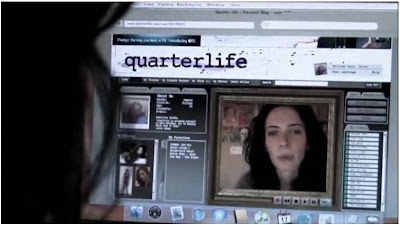
During the writers’ strike, more people took to getting their fiction on the Internet, and the strike was based on the assumption that this trend would continue. I wonder how the format will affect the shows. Will shows created for the Internet be different? Will shows look different if they are shot for two-inch iPods as well as 52-inch Sonys? Will the content be different? So far the show seems to me not up to the level of Zwick and Herskovitz’s earlier shows. I think that’s because the seven-minute format forces them to use heavy-handed plot manipulations where an hour format (45 minutes) allows things to develop in ways that seem more “natural.”
Beyond content, there’s the McCluhan question: what is the message of this medium? Right now, you can go the Website and see vlog entries from the characters. Were these created specifically as Internet content, or are they “deleted scenes” from the show? It doesn’t really matter. More interestingly, you can also see vlog entries from fans that are indistinguishable from the fictional vlogs. You can read the blog entries of the characters, and apparently you can send them a message, “add to friends,” etc. I haven’t tried it. I haven’t been able to get into writing to fictional characters since I stopped sending letters to Santa. But then again, I’m like so twentieth century.
Posted by Jay Livingston
A new television show starts tonight – Quarterlife. The show started on the Internet back in November. I didn’t hear about it until early this month and started watching because it was a Zwick/Herskovitz show. They are the guys who created thirtysomething, My So-Called Life (fifteensomething), and Once and Again (fortysomething). This time it’s twentysomething. I’ve seen thirty-two episodes. They’re short – about seven minutes each, not counting the credits.
The show was created as a hybrid. Quarterlife is not only the name of the show, it’s also a MySpace-like site that the characters use, posting their vlogs and sending vmail. But the creators of the show also made the site real, so that fans can use it in the same way the characters do.

During the writers’ strike, more people took to getting their fiction on the Internet, and the strike was based on the assumption that this trend would continue. I wonder how the format will affect the shows. Will shows created for the Internet be different? Will shows look different if they are shot for two-inch iPods as well as 52-inch Sonys? Will the content be different? So far the show seems to me not up to the level of Zwick and Herskovitz’s earlier shows. I think that’s because the seven-minute format forces them to use heavy-handed plot manipulations where an hour format (45 minutes) allows things to develop in ways that seem more “natural.”
Beyond content, there’s the McCluhan question: what is the message of this medium? Right now, you can go the Website and see vlog entries from the characters. Were these created specifically as Internet content, or are they “deleted scenes” from the show? It doesn’t really matter.
 More interestingly, you can also see vlog entries from fans that are indistinguishable from the fictional vlogs. You can read the blog entries of the characters, and apparently you can send them a message, “add to friends,” etc. I haven’t tried it. I haven’t been able to get into writing to fictional characters since I stopped sending letters to Santa. But then again, I’m like so twentieth century.
Subscribe to:
Posts (Atom)