Weed Arrests Are Not About Weed*

April 29, 2012
Posted by Jay Livingston

Arrest data for some crimes rise or fall with the amount of that crime.  If you see arrests for homicide increasing, you can be fairly sure that homicide itself is on the increase.  By contrast, an increase in arrests for prostitution is almost certainly the sign of a “crackdown.”  A higher level official – the precinct commander, the police brass, maybe even the mayor – has told the cops on the street to arrest more hookers. 

Neither of these explanations accounts for the trend in marijuana arrests in New York, particularly in the Bronx.  On Sept. 19, 2011, Ray Kelly, the NYPD commissioner, issued an order that police should not arrest people for possession of small amounts of marijuana, the personal-use weed that cops found in stop-and-frisks. 

The Guardian has published some graphs (here) showing the numbers of marijuana arrests in 2011 and in the previous three years.  These usually decline in the fall – cooler weather, back-to-school – and the Kelly edict should have steepened the slope.  But that’s not what happened.

(Click on the chart for a larger view.)

Keith Humphreys at The Reality-Based Community notes that marijuana arrests are often “substitute arrests.”  Just as a substitute drug is what you use when you can’t get the drug you want, a substitute arrest is one cops make when they can’t arrest the person for the crime they’d like to bust him for.   The cops might be doing whatever they can to punish someone witnesses might not want to testify against – a high-level drug dealer, a frequent wife-beater, or even a robber. Or the cops might be using stop-and-frisk marijuana arrests to get troublemakers off the street, at least temporarily, in order to maintain order.  Or they may be using the arrest to assert their authority (or from the arrestees’ perspective, throwing their weight around by hassling kids). 

“Substitution arrest” may be good explanation for why police bother to make these one-joint arrests.  But it does not account for the increase in such arrests following an order from the top to stop doing it.

I’m puzzled.


----------------------------
*The title of this post is derived from one of Robin Hanson’s favorite constructions   I’ve used it before (here), and I’ll probably use it again.

We Want to Have Our Appendix Out Too

April 26, 2012
Posted by Jay Livingston

How compatible are medical care and the free market?

The SocioBlog’s most viewed post (it got Boinged) showed widely varying prices among countries for the same medical products (hospital stay, Lipitor, OB delivery, office visit).  The US prices were four to ten times higher. 

Within the US, even within the same county, prices also vary widely.  Sarah Kiff at WaPo’s Wonkblog reports (here) on a study in the Archives of Internal Medicine (gated, here) that compared prices for an appendectomy.  The range: $1,500 to $187,000.  It’s as though the price of haircut ranged from $15 to $1870.   Even in the county with the least variation, the difference between the least and most expensive was $46,000.

It’s essentially the same service, though one haircut or appendectomy might be much better than another.  But not that much better.  These prices suggest that the usual market processes are not in play.  And they are not.  When I get a haircut, I pay the barber, and I check the price list before I go into the shop.  If my haircut insurance company were paying, I’d just walk in.

Also, unlike an appendectomy, my haircut is not an urgent production.  My untrimmed hair is not causing me to double over in intense pain, desperate for relief.  Even if I don’t act quickly, I won’t die.  I can take my time to shop around.  I can ask friends for suggestions, I can look for online reviews, and afterwards, I can form a reasonable opinion of the barber’s competence.  I’ve never had appendicitis, and unlike Miss Clavel's charges, I’m not eager for it.  But if my appendix were to start acting up, I’m sure I would not be a Consumer Reports type of consumer. 
 
The market is supposed to bring us more and better goods and services at a lower price.  With healthcare in the US, both the process and the outcomes suggest that this is not the ideal example of a market.

My Lunch With Charles

April 25, 2012
Posted by Jay Livingston

Charles Murray is the first author Nicholas Lemann discusses in his New Yorker piece (here) on inequality.  Murray’s recent book Coming Apart documents the moral decline of the white working class, and while Lemann doesn’t dispute Murray’s data, he is puzzled by Murray’s choice of villains – the liberal elite. They may live exemplary lives – work, family, religion –
But, unlike the elite of Victorian England, they don’t “preach what they practice.”  Somehow, this manifests itself in the breakdown of social more at the opposite end of society.

The elites, in Murray’s view, devote their free time to their own obsessions and diversions – exotic foods, chic wines, hybrid cars, and the like – when they should be driving their pickups to Applebee’s to talk about Nascar and the latest episode of “American Idol” with people who barely finished high school.  And somewhere along the way, maybe as everyone is lighting up a cigarette, they’ll slip in a few words about the benefits of a virtuous life.*

I’m sure that Murray, sitting at a table with people who voiced prejudiced, ethnic stereotypes would be quick to remind them that prejudice was not only nasty but economically unwise, since it excludes the capable and virtuous, and that trust, even of those outside our little tribe, is an important source of America’s success.

Several weeks ago, Edward Luce reported in the Financial Times on his lunch with Murray.  Here are some excerpts:  (The full article is here. )
Our venue is Al Tiramisu, a well-hidden Italian restaurant close to Dupont Circle . . . .

He is buoyed when the waiter says the black-truffle pasta is still on the menu, and we both order it as a starter. I have already said he must have a glass of wine. “Now, does the FT extend to a bottle?” Murray asks as he leafs through the wine list.

Our black truffle has arrived. Murray’s martini glass is empty. The waiter pours him a taster from the bottle of Gavi di Gavi, an Italian white wine. “Mmmm, it’s like a good Montrachet,” . . . I ask him what kind of wine a Gavi di Gavi is. Murray discloses that it is a “varietal”. I nod as though I know what that means. It certainly tastes nice. “Varietal means expensive,” he adds.
So much for Applebee’s and a Bud Light.

He discloses that he sometimes plays poker at a casino in Charles Town, West Virginia, and that he will, in fact, head over there after our lunch has finished. “The ways in which it reinvigorates your confidence in America is really interesting,” Murray says.

“I remember sitting at a table a couple of months ago. And at a poker table there’s lots of camaraderie. And so here I am at a typical table at Charles Town. Big guys with lots of tattoos, sleeveless T-shirts, one of them an accountant, the other looks like he comes from a gang. There was an Iranian-American and Afghan-American. Incredible polyglot mix of people – all speak perfect idiomatic English – and the conversation turned to the fact that my daughter was going to marry an Italian. ‘Well, do you trust him?’ they said. ‘You know, you can’t trust those Italians.’”

Murray guffaws at the recollection. “The thing is, it was such an American conversation.”

For what it’s worth, Luce includes the tab:
  • Black truffle pasta x2 $90.00
  • Sardines $15.00
  • Barramundi $28.00
  • Gin martini $14.00
  • La Scolca Gavi di Gavi $105.00
  • Cappuccino $4.50
  • Double espresso $7.00
  • Total (including tax) $289.50
-----------------
* These emblems are taken largely from Murray’s “How Thick Is Your Bubble” quiz in Chapter 4 of Coming Apart.  You can find all 25 items here.

Methodology in the News

April 20, 2012
Posted by Jay Livingston

1. “Survey Research Can Save Your Life,” says Joshua Tucker at the Monkey Cage. He links to this NBC news story about a woman who went into diabetic shock while on the phone with a student pollster working for Marist.  He sensed something was wrong and told his supervisor.  She spoke to the woman and then called 911.  (The news story does not identify the student working the phone survey, only the supervisor.  Nor does it say whether the woman approved or disapproved of Mayor Bloomberg.)

2.  The New York Times this week reported on a RAND study that found no relation between obesity and “food deserts.”  The study used a large national sample; it’s undoubtedly comprehensive.  The problem is that if you are using a national sample of schools or supermarkets or stores or whatever,  two units that fall into the same category on your coding sheet might look vastly different if you went there and looked at them from close range. 

Peter Moskos at Cop in the Hood took a closer look at the RAND study, reported in the Times, RAND relied on a pre-existing classification of businesses. The prefix code 445 indicates  a grocery store. Peter, an ethnographer at heart, has his doubts:
New York is filled with bodega “grocery stores” (probably coded 445120) that don't sell groceries. You think this matters? It does. And the study even acknowledges as much, before simply plowing on like it doesn't. A cigarette and lottery seller behind bullet-proof glass is not a purveyor of fine foodstuffs, and if your data doesn't make that distinction, you need to do more than list it as a “limitation.” You need to stop and start over.
3.  NPR’s “Morning Edition” had a story (here) on death penalty research, specifically on the question of deterrence.  A National Research Council panel headed by Daniel Nagin of Carnegie Mellon University reviewed all the studies and concluded that they were inconclusive, mostly for methodological reasons.  For example, most deterrence studies looked at the death penalty in isolation rather than comparing it with other specified punishments. 

Another methodological problem not mentioned in the brief NPR story is that the number of executions may be too small to provide meaningful findings.  For that we’d need a much larger number of cases.  So this is one time when, at least if you are pro-life, an inadequate sample size isn’t all bad.

New York Education – Gifted, Talented, and Crazy

April 14, 2012
Posted by Jay Livingston

Individual facts may be very useful for explaining other individual facts. But in explaining social facts, they don’t always get us very far. This Durkheimian notion is one of  the first ideas I try to convey in my course (the first in our sequence of core courses for majors). 

Newspaper stories sometimes provide good bad examples. The New York papers today report on the results of the Gifted-and-Talented tests for public schools. Times recently ran a story with this headline:
After Number of Gifted Soars,
a Fight for Kindergarten Slots
Most of the article is about test prep for tots. It quotes Robin Aronow, former PS 9 parent, now an “admissions consultant”
[test prep] certainly seems to be having an influence.  There are more and more people who are putting their kids through some sort of test preparation, whether it’s buying the materials or using the test-prep companies . . .  I think the nursery schools have begun to integrate some of the materials into their classes as well.
No doubt, the trend is real.  Here are the numbers.


It’s possible that shelling out $150 an hour or more for test prep might improve your kid’s chances of making the G&T cutoff.  But these individual facts do not explain the doubling of numbers and percents shown in the graph.  If there’s any connection, the causal arrow will point the other way: increases in G&T qualifiers causes parents to buy test prep for their kids.    

What is driving the increase if not better test prep?  My guess is economic history. The recession has changed the population of test-taking tots; it now includes more kids from well-educated, better-off families. These parents, who once might have sent their kids to private school, have been discovering the virtues of public education, especially if they do the math and realize that over the K-12 span, that $40,000 a year adds up to a half million.  A demographic trend the Times story mentions – more families staying in the city rather than moving to the suburbs – contributes to the same effect.

When my son took the test for New York high schools, I commented to the dad of another test-taker that 27,000 kids were taking the test that day. He was unfazed by the apparent odds. “Twenty-five thousand – background noise,” he said.

That ratio of real competition to background noise has shifted, especially for kindergarten hopefuls, thanks to those economic and demographic changes. As a result, according to a test prep company founder, “the idea of preparing for the kindergarten test is totally the norm.”

If you don’t live in New York City, you may look at these norms – $150-an-hour test-prep courses for a four-year-old – and think, “Are these people crazy?”  I thought that way myself once.  I grew up in a Pittsburgh suburb (pop. 40,000). For K-6, kids went (usually on foot) to the local elementary school. There were two junior high schools (you went to the closer one) and one high school. No choice, no questions asked. Not until it was time for college did we survey our choices, visit schools, send off applications, take standardized tests, and go for interviews. In New York, middle-class families do all that for kindergarten and even pre-school. And many do it again for middle school and again for high school.  

I thought it was crazy, but still I did it.  My kid  was four.  “This is crazy,” I said to the test-giver, a psychologist, “scores for kids this age aren’t stable or predictive.”  She nodded.  Welcome to education in New York city.  

white on White

April 10, 2012
Posted by Jay Livingston

“Black is not a color,” says Philip Cohen in a blog post  explaining why he has decided to use upper case when writing about Black and White as racial categories. I agree. The title of that post is a tad coy. A more straightforward title might be, “black is a color, Black is a race.”  (I think the style manual still says to use italics when you refer to a word as a word.) 

It’s a small change, upper case for lower case, but it might move us one step away from the frequent conflating of the racial and the chromatic.

My favorite example of this color/race tangle happened here at Montclair.  A few years ago, the University became home to the work of artist George Segal, famous for his life-size, white-patina-on-bronze sculptures.  Montclair has, as our Web page boasts, “the only George Segal art gallery in the world.”  It’s housed in the most important building on campus, the parking garage.  Close by is this 1992 Segal sculpture “Street Crossing,” which came to the University in 2006 when the gallery opened.  (It has had two or three different placements.)


The Public Art Fund describes it this way:
Caught in an ambiguous psychological terrain, the seven figures seem blind to one another and to their surroundings. Segal had a particular ability to elevate mundane day-to-day activities into a lyrical or elegiac display, depicting his subjects with their guard down and in a naturalistic stance.
Maybe so.  But shortly after the sculpture was installed, a non-faculty employee here wrote to the president of the university from a different critical perspective.  The letter said, in effect, “This university prides itself on its efforts for diversity.  And then the biggest deal on campus is this sculpture of nothing but white people.”

The president wrote back explaining that the sculpture was a work of art blah, blah, blah.  And perhaps the employee was mollified.

But the problem here is not Art appreciation; the problem is not even race and diversity.  The problem is language. We need two words where we have only one.  Here’s another photo of the Segal piece.


After I heard the president tell this story, I asked our undergraduate assistant Heather to let me photograph her standing next to one of the figures in the sculpture.  Heather is, undoubtedly, a white girl.  She has very fair skin. Compared with her, I look positively swarthy. (Heather is also very good looking, and this photo, taken in strong sunlight – terrible light for photography – and unretouched, does her a real disservice.) Her skin is not the color of the Segal figure.

Still, we seem to be stuck with the same word, white, for both Heather and for the figures in the sculpture. But they are obviously not the same. No White person, even the palest and fairest, is that shade of white. If the word for White as a race were different from the word for white as a color, the offended employee might never have found cause to complain.  She would not have seen the sculpture as a bunch of “White people.”  

Do we have such a word?  Caucasian might do – you couldn’t say that the Segal figures were Caucasian – but the term is too long, and it implies a geographical link to the Caucasus that most White people don’t share. Besides, it’s part of a typology which has gone out of fashion in this country.

So at least for now, the only way I have to make the color/race distinction is with the shift key.

Is This Racist?

April 8, 2012
Posted by Jay Livingston
“The Haves and the Have Nots” said the marquee on the Beacon Theater.  I thought maybe it was a rock group, you know, like The Mamas and the Papas. 

We met our friends – a couple and their kids age 14, 17, and 23 – at a restaurant just around the corner.  I asked the three teenagers if they’d ever heard of such a group.  No.

It was early, 5:30, and there were only a few other diners in the place, mostly middle-aged African Americans.  Then it dawned on me – pre-theater dinner.  “I wonder if it's one of those Tyler Perry plays,” I said. 

My wife shot me a look and a very brief sentence, both of which meant, “Shut up.   You'll probably say something offensive and loud enough to be heard by these people at the table behind us.”

I knew that she was afraid I'd use the term chitlin circuit.  And maybe I would have.  I’d used it before.  In public.  But dammit, Skip Gates used the term in the New Yorker in a wonderful article about this genre of drama.  If he can, why can’t I? Or is chitlin circuit* one of those terms like the N-word that can be used only by the in-group?  What other words have this OK-for-us-not-for-you quality?

When I got home I Googled “The Haves,” and indeed it is a Tyler Perry play.  I reread the Gates article, written in 1997, before Perry became so successful.  It holds up.

I’m thinking of buying a ticket and going.  John Darbyshire, the National Review writer, would tell me that I’m risking life and limb.  Now that’s racist (his rant is here, but don’t say I didn’t trigger-warn you).

----------------
*  Wikipedia says that “chitlin circuit” is “now also known as the ‘urban theater circuit.’”

Reporting Numbers Truthfully

April 7, 2012
Posted by Jay Livingston

We have a hard time understanding or accepting indeterminacy.  We want our economic reports to have the same finality as sports scores.  The Rays beat the Yanks yesterday 7-6, and Carlos Peña’s grand slam and ninth-inning single had a lot to do with that outcome.  We want the same kind of precision of results and explanations in economic news – for example, yesterday’s jobs report – so  that’s  what the media give us.

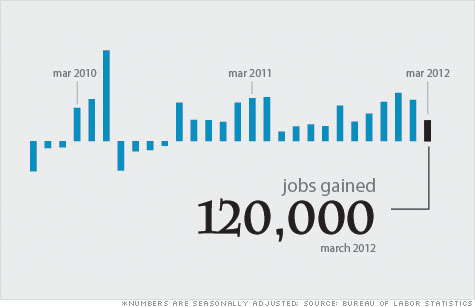
Here, for example, is what CNN Money said.

March jobs report: Hiring slows, Unemployment falls

April 6, 2012: 2:47 PM ET

American employers hired 120,000 workers in March -- half of the job gains seen in February.

American employers hired 120,000 workers in March -- half of the job gains seen in February.
NEW YORK (CNNMoney) -- Hiring slowed dramatically in March, clouding optimism about the strength of the recovery.

Employers added 120,000 jobs in the month, the Labor Department reported Friday, falling far short of economists' expectations.

Meanwhile, the unemployment rate fell to 8.2% as the labor force shrank by 164,000 workers, mostly due to white women leaving the job market.
Economists attributed part of the hiring slowdown to an unseasonably warm winter that boosted job growth in January and February [blah, blah, blah . . . ]

 But economic numbers are sports scores.  R.A. at The Economist* rewrites the story:
  There is a 90% chance that employment rose by between 20,000 and 220,000 jobs. The change in the number of unemployed from February to March was probably between (roughly) -400,000 and 150,000, and there's a good chance that the unemployment rate is between 8.1% and 8.5%. Reported changes for important subsectors are too small relative to the margin of error to be worth discussing. In all probability, the employment growth has remained close to the recent trend of a 200,000 jobs per month increase.
--------------
*The Economist, for some reason, insists on initials rather than names in its by-lines.

Injuries and Incentives - Saints and Sinners

April 6, 2012
Posted by Jay Livingston

Did the bounty system work?

Even people with no interest in sports have heard about the strategy of Saints defensive coordinator Gregg Williams.  He offered his players a bounty for injuring opposing players – $1000 if a player was carried off the field, $1500 if the player didn’t return to the game that day.

On the audio released yesterday (listen here), you can hear Williams giving pep-talk instructions to to the defense just before the playoff game against the 49ers.  He specifies the injuries he would particularly welcome – a blow to the chin for quarterback Alex Smith, a concussion for receiver Kyle Williams, and as for receiver Michael Crabtree, “He becomes human when we fuckin’ take out that outside ACL.”

Much of the reaction to this story is shock and horror – some of it real, no doubt, by people unaware of football’s backstage, and some of it affected.  Among the players, there is anger and genuine surprise.  (“One word WOW,” tweeted 49rs safety Reginald Smith.)  Others were more sanguine, saying in effect, that football is a violent game where people get injured.  Jets linebacker Bart Scott said that getting rid of the bounties wouldn’t change that. 

But so far I have seen no data on whether the bounties worked.  Did the Saints injure more players than did other NFL teams?  Surely those numbers are available. 

The only evidence I’ve heard is that the Saints had the highest number of roughing-the-passer penalties in the NFL.  That’s probably because they blitz more.  Blitzing is a high-risk strategy, and there’s some question as to whether it’s effective.  In theory, blitzes should increase the defense’s chances of injuring the quarterback.  But the Saints were below the NFL median in sacks. 

None of that speaks directly to the question of injuries.  The bounty system is a recent and distasteful example of “incentivizing” (a recent and distasteful coinage among economists).  Has no sports economist or Freakonmist even counted up the injuries let alone run econometric statistics to see if these incentives worked?

The Jewish Vote, Abortion, and Status Politics

April 4, 2012
Posted by Jay Livingston

The “Jewish vote” came up on Fresh Air yesterday.  The interviewee was Peter Beinart (for the audio and transcript go here), and most of the interview was about Israel, specifically his proposal that Americans boycott products from West Bank settlements. 

Towards the end of the interview though, Beinart said that despite the controversy over his proposal, and despite politicians’ ringing statements of stout support for the Jewish state, Israel was not much of a factor in the Jewish vote.  But if not Israel, then what?
The single biggest driver of the Jewish vote in America is actually abortion.*
On the surface, this makes no sense.  Does the Talmud or any of the commentaries tell us that abortion is a mitzvah?  Does abortion directly affect the lives of many Jews – either as doctors or as patients?  I doubt it.  Instead, at least for American Jews, abortion is a matter of status politics.  Its symbolism far outweighs its practical consequences.

Issues inflated with the air of status politics are important because they signal the relative status of different groups.  These are the issues that usually get classified as “values” issues, a matter of morality.  But the important question is “whose values, whose morality?” because the answer to that question is also the answer to the question, “Whose country is this anyway?” 

My guess is that to American Jews, abortion looks like the flagship of conservative Christianity, with its assertion that America is a Christian country and should be run on principles of Christianity.  Beinart is more circumspect.  He frames the issue as “religious / secular” rather than “Christian / Jewish.”
American Jews are very strongly committed to an agenda of cultural tolerance, probably, in fact, because they're actually very secular. American Jews are much more secular than are American Christians
Maybe so.  Either way, it’s status politics.  It’s about which group – its customs, its morality, its symbols – will be honored as dominant.  So when politicians (invariably Christian politicians) rail against abortion, what Jews hear them saying is “This land is our land, this land’s not your land.”  

(Previous posts on status politics are here and here.)

 ----------------------
* I haven’t checked the data, but Beinart sounded as though he’d done his homework on this one.

UPDATE:  PRRI yesterday released a survey of 1,000 Jewish adults (pdf is here).  The main issue, by a mile, for the 2012 election was the economy.  Israel, as Beinart said, was a minor concern.  But abortion ranked even lower.
Other issues that fall at the bottom of the priority list are national security (4%), Israel (4%), Iran (2%), the environment (1%), immigration (1%), same-sex marriage (1%), and abortion (1%).
Beinart was necessarily basing his statement on earlier surveys. Possibly, when the economy was not so clearly the big issue, the status politics issues were more important.  

The PRRI survey makes clear that Jews are liberals, not conservatives.  One minor factoid.  One question asked how well each of several public figures represents Jewish values.”  Leading all others in the not at all well” category was Eric Cantor with 35% saying he was a poor representative of Jewish values.  The figure was significantly higher than Sarah Silverman’s 26%. 

Handling the Truth

April 3, 2012
Posted by Jay Livingston

We can’t handle the truth.  We want all the facts to fit with our picture of the world.

The “Mad Men” scripts (see last weeks post ) use words and constructions unknown to real 1966 ad men.   These anachronisms sound “right” to us despite their historical inaccuracy.   And historical facts may sound wrong. 

The Times TV critic saw the “Mad Men” season opener and complained:
The themes of civil rights and equal opportunity thudded into view in a couple of unfortunately ham-handed scenes, one involving the scamps at Young & Rubicam dropping water bombs on picketers (“And they call us savages!” an indignant protester exclaimed) . . .

Bad scene, bad line.  “It’s a terrible line that should have been red-penciled,” said the New York Magazine critic.”  The only trouble is that it’s all taken directly from a 1966 news item in the New York Times.


(This is a screen grab.  To see the full 1966 Times story – and if you saw 
the episode of “Mad Men” you must read it – go here. )

Far from being disarmed by the facts, the critics stood their ground when informed of the historical accuracy.  The Times critic still insisted that the scene was bad and that the line, a true quote, “just rings so false.”

The critics are right, of course.  All the news that’s fit to print does not make for good drama.  A scriptwriter or novelist has to select and shape the facts and edit the language.  What fictional people do and say must not clash with character. 

This preference for a coherent story, a perfect congruence of character and action, becomes a problem when we use it to filter reality and then think that this filtered reality is “the truth.”  But that’s another story.

Following the Money

April 2, 2012
Posted by Jay Livingston

In the politics of wealth and taxes, the dominant emotion in the US seems to be righteous anger.  The Occupy movement looks at the 1% and thinks they are getting too much money and paying too little in taxes.  The Tea Partiers complain that the government is picking their pockets and giving too much to the poor, who are not paying enough in taxes. 
Here are two graphs that might be relevant.

First, of the total increase in income in the US in 2010, who got how much? 

(Click on the graph for a larger view.)

This Piketty and Saez graph was included in an article by Steven Rattner at the New York Times website (here).  It’s a little misleading because that $80 apiece increase for the 99% was not evenly distributed.  I would imagine that in the lower 50% the increase was meager at best.

At the same time, have rising tides been lifting all boats?  That depends on which country your boat is floating in. 

(Click on the graph for a larger view.)

The income of the median US earner hasn’t moved much in the last twenty years.  That includes the economically sunny 1990s.   In some other countries, everyone seems to be doing better.  (This graphic, found here, comes from a report nearly a year ago.  I discovered it today thanks to a link from Matt Yglesias at Slate.) 

I would guess that the anger over income and taxes would be less pronounced if incomes had been rising.  The signs from the 99% were often complained that they could not find jobs, at least not jobs that would allow them to make even a small dent in their student loans.  What rankles them is not just that incomes at the top are soaring but that incomes for the middle have become insufficient.  On the other side.  It’s even possible that Republicans, had their incomes been rising steadily, might not be so resentful about tax-funded safety-net programs.

AKD - 2012

March 31, 2012
Posted by Jay Livingston

We had our annual Alpha Kappa Delta induction ceremony Thursday evening. ΑΚΔ is the sociology honor society, and the students who join are not only the best and brightest (ΑΚΔ has a minimum B+ average requirement), but they’re the ones who have some commitment to sociology.  They’re the ones we like to have in class.   At the ceremony, we get to see them a little more dressed up than usual, and we get to meet their parents, if only briefly.


From left to right
  • Pamella Salgado
  • Jessica McCabe
  • Francheska Martinez
  • Samantha Gowe
  • Nadia Ibrahim
  • Tiffany Holoubek
  • Brienna Rauhauser
  • Atika Rahaman
  • Benjamin Rhodes
Our speaker was Jenn Lena, author of the recently published Banding Together: How Communities Create Genres in Popular Music.  Jenn has done radio interviews about the book, but she says that this was her first “official” book talk.  She used rap as her example of a music that has evolved through the sequence of genre types – Avant Garde, Scene Based, Industry Based, and Traditional.  Good choice, I thought, it’s certainly something students will know. But I was surprised that it was only a few of the parents in the room who knew of Grandmaster Flash and the Furious Five.  I also noticed one of those parents – and no one else in the room – rapping along quietly when Jenn played Run DMC’s “It’s Tricky.”   So rap now has a generation gap; it’s a “traditionalist” genre.  (Jenn also pointed out that it had a genre gap much earlier, with the arrival of gangsta and other variants.)

A great talk.  A great group of students.  A great evening. 
Same time next year.

UPDATE April 1:  After Jenn’s talk, it occurred to me that the Broadway show  “Million Dollar Quartet,” which I blogged about two years ago (here) is really about the transition from Scene-based to Industry-based.  The setting for the show is the scene-based studio of Sam Phillips’s Sun records, but we are looking at the end of an era.  Elvis and Johnny Cash are leaving for industry-based giants like RCA. 

Stacked Bar Graphs

March 30, 2012
Posted by Jay Livingston

To create stacked bar charts, I usually use Excel.  But whoever* created these used Legos, a children’s diversion, appropriately enough.  Numbers 5 and 8 are based on French -Belgian data**, so you may find them harder to interpret.

(Click on the graphic for a slightly larger view.)


* The farthest I can trace this back is actor George Takei, who posted it on his Facebook page.  I expect that it is zooming around the Internet fairly quickly.

** For original data go here and here.

American Lit – It’s Still the Same Old Story

March 29, 2012
Posted by Jay Livingston

In Commentary, D.G. Myers (here) asks:
Has the literary scholars’ 25-year worship at the holy shrine of race, class, and gender brought about major changes in the canon?
Since Allan Bloom and probably before, the folks on the right have been wailing that liberal American lit profs were scrapping the canon in favor of politically correct trash.  Myers follows his snarky question with some evidence – the number of “pieces of scholarship” an author has received in the past 25 years, according to the MLA International Bibliography. 
The number in brackets, Myers says, represents  “the rise or fall of each writer when compared to his or her ranking since 1947.”

( 1.) Henry James (3,188 items) [+1]
( 2.) William Faulkner (2,955) [-1]
( 3.) T. S. Eliot (2,659) [+1]
( 4.) Herman Melville (2,579) [-1]
( 5.) Vladimir Nabokov (2,290) [+5]
( 6.) Ernest Hemingway (2,220) [-0-]
( 7.) Edgar Allan Poe (1,958) [-2]
( 8.) Toni Morrison (1,950) [+9]
( 9.) Nathaniel Hawthorne (1,751) [-4]
(10.) Walt Whitman (1,647) [-2]
(11.) Emily Dickinson (1,623) [+2]
(12.) Ezra Pound (1,620) [-3]
(13.) Willa Cather (1,482) [+5]
(14.) Ralph Waldo Emerson (1,326) [-3]
(15.) Wallace Stevens (1,122) [-1]
(16.) Edith Wharton (1,087) [+5]
(17.) Henry David Thoreau (1,076) [-5]
(18.) F. Scott Fitzgerald (1,002) [-3]
(19.) Flannery O’Connor (935) [+3]
(20.) Mark Twain (882) [-4]
(21.) John Steinbeck (823) [+2]
(22.) William Carlos Williams (772) [-0-]
(23.) Saul Bellow (706) [+2]
(24.) Richard Wright (670) [+2]
(25.) Robert Frost (661) [-5]

Can that number in brackets really be change of rank since 1947?  If so, in 1947 Nabokov was ranked 10th, though at that time he had published only two books in English, both largely unnoticed; Toni Morrison would have been ranked 17th in 1947, the year she turned 16.  Myers must mean since 1987, 25 years ago.

But whatever that number means, it does show an increase for all five women and the one African American male on the list.  That increased attention to women writers may reflect an increase in the number of women scholars.  Or maybe just the recognition that Flannery O’Connor was a very good writer (though both she Nabokov dwelt far from political correctness).

But for the most part, the canon hasn’t changed much.  American lit scholars are still cranking out articles on good old Henry James.  The Commentary insinuation that liberalism is transforming American culture, replacing noble classics with tawdry tracts – that moan is utterly predictable (I think
Commentary has a regular section called Geschrei).  But the message in the evidence seems to be: same old, same old.

“Mad Men” Language – Ahead of Its Time

March 28, 2012
Posted by Jay Livingston

Matthew Weiner, creator of “Mad Men,” was on “Fresh Air” yesterday talking about the new season. June of 1966 as the show opens.  Civil rights demonstrators are in the street.  Things are changing, Weiner says – hair styles, clothes, mores.  And
, he says The language is becoming more modern.”

Maybe too modern.  I noticed the following anachronisms:

1.  Speaking of airline accounts, one of the ad men says
The American Airlines thing isn’t happening. 
The first three words are all right.  But thing (maybe) and isn’t happening (certainly) sound wrong, at least to my ear.

2.  I’m less sure of other advertising terms.  There is a reference to
niche companies and a key demographic
I suspect that these terms come later in the evolution of marketing strategies and language.

3.  Joan’s mother is trying to tell Joan what to do regarding work and family (Joan has a newborn).  The mother refers to her own decision in similar circumstances.  Joan says acerbically 
And how did that work out for you?
This sarcastic phrase is much more recent.  In 2010, Sarah Palin could say, Hows the hope-y change-y thing working out for you?” It was effective and funny not just because of the idea but because the language was fresh, not something that had been around for fifty years. Note also Palins use of thing to make little of something. (I mentioned this linguistic trick in a footnote to a post (here) on the Anti Asian rant in the library,” where the ranter refers to the tsunami thing.”)

4.  Another character uses “Plus” to begin a sentence.  I don’t think that this usage came into fashion until decades later. Plus, it’s grammatically questionable.

5.  Finally the most glaring anachronism: Peggy is pitching her ad for Heinz canned beans to the client.  Peggy describes the ad – dancing beans pirouetting, then the can seen from the top, and finally
We cut to the front, the iconic label.
No, no, no.  In 1966, nothing was iconic.  There were no icons except maybe the statues in Orthodox churches, and these rarely came into the conversation.  If icon was heard at all, it  was more likely as part of the word iconoclast

I’m sure that Matthew Weiner insists that every piece of clothing, every automobile, sofa, and refrigerator, every can of beans that appears on the show be historically accurate.  He probably hires experts to make sure that people are not brushing their teeth with some toothpaste that wasnt on the market until 1980.  Why is he less meticulous about the language in the scripts he writes?

UPDATE:  I wrote this blog using only my own sense of what language was like in 1966.  I did no research.  Now I find that others have also commented on anachronisms in the show.  Benjamin Schmidt in The Atlantic does not mention any of the terms that I noted, but he did pick up others
There are scores of idioms that are strikingly modern. feel good about, match made in heaven, tough act to follow, make eye contact, fantasize about; all are at least tenfold more common today than in Mad Men's times.
Most interesting and least visible (at least to me) is the use of “need to.”  In the 1960s, people were more likely to use “ought to.”   “You need to do something about that account.” (I am making up this example, but it does sound like something Don Draper might have told someone.)  The example Schmidt uses is a real one from Season Two:  “Tell Jimmy I need to talk to him.”  In the real 1960s, “ought to.”

Schmidt adds that the difference is significant. Need implies a focus on the self. Instead of the general moral codes of ought, we now have the language of personal needs. Schmidt provides some systematic evidence. He calculated the ratio of “need to” to “ought to” in scripts from the 60s and scripts from the last five years. In most of the 1960s scripts, the ration is at least ten to one in favor of “ought to.” In the more recent scrips, its twenty to one for “need to.”

( Click on the graph for a larger view.)

UPDATE 2: Philip Cohen, in an unpublished comment on this post, went to Google Ngrams and entered “that work out for you.”  It remains flat through the Mad Men 60s, then rises in the late 70s.  The rise in “that working out for you” comes even later, in the mid-90s. 

Following Philip’s lead, I tried the other terms in this post with similar results.  “Isn’t happening” and “iconic” appeared in the late-60s with less than 1/15th the frequency that they do today.  “Niche company” and “niche marketing” are virtually 0 until the mid-80s.  “Key demographic” starts its rise only a few years before that.  Unfortunately, I cannot figure out how to search for “plus” as the start of an independent clause.  My Lexis-Nexis searches for “niche marketing” and “key demographic” came up empty for the 1960s.  Even niche and demographic are rare.

Names on the Map

March 27, 2012
Posted by Jay Livingston

The National Geographic has an interactive map (here) of the most frequent names in the US.  Here is our mid-Atlantic region.

(Click on the image for a larger view.)


It’s tempting to read the names as a proxy for ethnicity, as the color coding implies.  The green Kelly and Murphy show that those are those common Irish names.  But what about the Williamses?  On the map, they’re all Welsh blue.  But in person, their color is not nearly so uniform.  I doubt that Juan (of Fox News) and Deron (of the Nets) trace their ancestry back to Wales.  (However, National Geographic does make some distinctions.  The Lees in the central part of the map are Chinese.  The Lees further down the coast are English.  National Geographic counts Martin as Spanish in California but English in other parts of the country. )

I’d also like to see an interactive map that showed the change in ethnic concentrations over time.  When I first started teaching at Montclair a few decades ago, I used to joke that on my class list, the C-Cathys were Italian, and the K-Kathys were Irish, and that accounted for a lot of the class.  This semester, more than a quarter of my students have Hispanic surnames, though not the more popular Rodriguez and Gonzalez on the map, and they far outnumber the Italian and Irish. 

HT: Ezra Klein, where I found this link.

Piety, Politics, and the Press – New York Edition

March 25, 2012
Posted by Jay Livingston

The Venn diagram of American culture shows a large overlap of political conservatism and Christian belief.  Folks who take their Christianity seriously (and their Bible literally) can be counted on to vote with Fox News.  Those who mock Christian piety even mildly are over on the left side of the room watching The Daily Show.

Not in New York. 

I was listening to the Christian radio station (officially “family radio”) on my drive home*  the day Peyton Manning signed with the Broncos.  The announcers main concern of course was what would happen to Tim Tebow.  They did not speculate much as to where Tebow would wind up, but they did assure me and my fellow listeners repeatedly that the Manning deal was evidence that “God has a plan.”  

A few days later, Tebow was on his way to New York and the Jets.  If you thought the New York Post would treat God’s plan with the appropriate respect, think again.

The New York Post, brought to you by the same Rupert Murdoch gang that owns Fox, is reliably right-wing on just about any political matter you can think of. But when the Manning/Broncos deal went down, the Post front page report on Tebow-Jets rumors was not quite in tune with the church choir.


The Post continued this irreverent tone when the Jets did sign Tebow.  The front page had a photoshopped picture of a towering Tim, Tebowing over Times Square.


Today, the Post tone on Tebow seems to be  bordering on sacrilege.  The QB is shown topless in a crucifix-like pose – arms outstretched, head turned to the side, legs crossed at the ankles – over the headline “The Passion of the Tebow.” 

(Previous Post posts in this SocioBlog are here and here.)
-------------------
* If you must know, this is what happens when you’re not interested in the guy Terri Gross is interviewing and you hit the Scan button.

The Decline of Car Culture

March 23, 2012
Posted by Jay Livingston

(I was going to call this post SocioBlog Scoops the Times - By Five Years”)

Nearly five years ago, a post on this blog said
cars may have lost their symbolic value as markers of identity.
Today, a front-page story in the Times  says
many young consumers today just do not care that much about cars.
My comment came after I’d been watching “American Graffiti” on TV.  My teenage son was in the room, and it just seemed to me that while the cars in the movie carried so much meaning for me, the cars of his generation were at best transportation, at worst nuisances or eco-villains.  As I put it five years ago,
Occasionally, I would offer an astute cinematic comment like, “The fifty-eight Impala, what a car.”   But later as we were talking about it, my son wondered what sorts of things from today would trigger the same kinds of response forty or fifty years from now.  “Will we look at a movie and say, ‘Wow, a 2007 Accord!’?”
Or as the Times says today,
That is a major shift from the days when the car stood at the center of youth culture and wheels served as the ultimate gateway to freedom and independence. Young drivers proudly parked Impalas at a drive-in movie theater, lusted over cherry red Camaros as the ultimate sign of rebellion or saved up for a Volkswagen Beetle on which to splash bumper stickers and peace signs.
This loss of iconic status for the car is not universal.  It has happened primarily among the current counterparts of the kids in “American Graffiti” – white, middle-class, mostly suburban. Young, urban African Americans may still prize their ride.  In the 1960s, we had the Beach Boys, an unquestionably white group, singing about T-birds, 409s, and deuce coupes, while their imitators paid homage to Barracudas, super-stocked Dodges, and many others.  For today’s equivalent, you have to go to the rappers, who favor Beamers, Benzes, Bentleys, Escalades, and Lamborghinis.


It’s Not So Hot Being a Republican


March 22, 2012
Posted by Jay Livingston

Hot enough for you?  Your answer might depend on who you’re voting for.

World views affect not just how we interpret what we see; these views influence what we actually experience.  That was the point of the previous post.

Do people who reject the idea global warming perceive the weather as being cooler?  Gallup just published the results of a poll (here) that asked people if this winter was warmer than usual. Unfortunately, Gallup asked only for political affiliation, but it can stand as a rough proxy for ideas about global warming.  So the data are suggestive, not conclusive. But for what it’s worth, Democrats were more likely than Republicans to say yes, it’s been a warm winter.  Some of the difference can be attributed to geography (Democrats living in places that had a much warmer winter than usual). But I suspect that at least part of the 11-point difference is political.  


Republicans reject the idea that the world is getting warmer – that’s a question of science – but they also experience their own immediate environment as cooler, which is a matter of perception.

As the graph shows, Gallup then asked those who did think that the winter was unusually warm what they thought the cause was – global warming or just normal variation..  As you might expect, political affiliation made a difference.   Democrats were more than twice as likely as Republicans to cite global warming as the cause.

Faulty Cognitive Wiring and the News

March 21, 2012
Posted by Jay Livingston
(Cross-posted on April 18 at Sociological Images)

Have you heard about the killing of Trayvon Martin?  Even if you watch the news channels, the answer might depend on which one you watch.  ThinkProgress counted the number of stories about this killing on three cable news outlets in the week following the event. 


Megan McCardle (here) interprets the data as an example of “the Availability Heuristic, a rule of thumb that says the frequency of an event should correspond to how quickly you can think of examples of it.”  The Availability Heuristic makes us overestimate the risk of shark attacks.  The Availability Heuristic is probably behind my students’ writing confidently that teenage pregnancy has been steadily rising (thank you, MTV). 

McCardle looks at the graph and sees a reason for different perceptions of racism as a problem:
the disparity here may have something to do with whether one thinks institutional racism remains a serious problem in the United States. Conservatives often seem to think it isnt, and that if anything, the real problem is how often spurious charges of white racism are deployed by their political opponents, while liberals more often tend toward the opposite view. Maybe both groups are drawing justified inferences from the data theyre seeing.
Do Fox viewers discount racism because of what they see?  Or is the network disparity more an example of another cognitive wiring problem – Confirmation Bias?  Confirmation bias is our tendency to seek out and to remember information that fits with our existing ideas.  Faced with information that clashes with that world view, we ignore, forget, distort, or misinterpret. 

In Foxland – the world of both those who create Fox news and those who consume it – racism is not a real problem.  A story of a white Hispanic man armed with a 9mm chasing down and shooting a black teenager armed only with Skittles has no place in that world.  The Fox news producers don’t want to tell that story, and the viewers don’t want to hear it.  In the days since this graph appeared, the story has become too big for even Fox to ignore. I would imagine that Fox will instead interpret the events so as to fit with the view that McCardle suggests – that whites are the victims.  If you watch Fox, get ready to hear a lot about self-defense.

Subtle Ben

March 21, 2012
Posted by Jay Livingston

Ben Bernanke defended the Fed yesterday.  He explained the origins and functions of his little organization, and he explained the wisdom of FDR’s decision to abandon the gold standard.

Ostensibly, he was lecturing to a handful of George Washington University students.  In fact, his intended audience was the whole country and perhaps a former TV host and a politician or two with retrograde views on central banks and gold (“I’m looking at you, Ron Paul.”  No, he didn’t say that, but he might well have done so.)

His PowerPoint included a few slides on the gold standard, all with the same graphic.


And in case you didn’t catch the subtlety of those ingots, this part of the lesson was followed immediately by a detour through William Jennings Bryan and his “cross of gold speech.”


If you missed class, you can get the notes and slides here.

Friends, Kids, Sex


March 18, 2012
Posted by Jay Livingston

The set-up of “Friends With Kids” seems very contemporary.  Jason and Julie (Adam Scott and Jennifer Westfeldt) are  besties who decide to have a baby yet remain just friends.  They live in the same building, so they easily share baby-care while each continues to search elsewhere for a soul mate. Their open talk to each other about their sex lives is also something you don’t usually hear in romantic comedies. 


But the movie plays on an idea that goes back many decades. As Jeannette Catsoulis in the Times review put it, the “jokes about vaginal elasticity (in this case lack thereof) and other formerly unmentionable female concerns” seem like an attempt “ to veil the retrograde themes lurking behind them.”  Catsoulis doesn’t specify those retrograde themes, but the principle one is this: the assumption that marriage and children spell the death of romance and sexuality. 

In the early TV family sitcoms of the fifties and sixties, this assumption was a taken-for-granted part of the landscape.  It wasn’t just that prudish standards required separate beds for Ozzie and Harriet, Rob and Laura Petrie, Lucy and Ricky, and the other couples.  Their kisses and hugs were friendly, never passionate. There was never a hint that sex might exist between them. Even by the seventies, when Archie and Edith could share a double bed, we could be pretty sure they wouldn’t be doing much there except sleeping. More recent sitcom couples have been allowed to acknowledge sexuality, maybe because these are characters whose erotic encounters most viewers might prefer not to think about – Dan and Roseanne, Homer and Marge, Peter and Lois. 

In “Friends With Kids,” one of the two married couples (Maya Rudolph and Chris O’Dowd) comes straight from this old sitcom stockroom. They are relatively happy and funny, but sex is a rarity.   Once a month, O’Dowd tells Scott.


The other couple (Jon Hamm and Kristen Wiig) are married but sexy (they first appear on screen in a restaurant, returning to the table after a quickie in the bathroom). 


Over the course of the film, they suffer the same loss of sexuality, but their very non-sitcom marriage cannot survive it (“Once, she gave me a blow job on the Taconic,” Hamm shouts angrily in an uncomfortable dinner-table scene, “Now look at us!”)

It may be particularly American, this idea that parenthood makes sexuality impossible or irrelevant, and it may have something to do with our view of children and childhood.  In France, says Elaine Sciolino in a review of Bringing up Bébé by Pamela Druckerman, mothers “refuse to make child-rearing an all-consuming vocation. Rearranging your schedule to fit the baby’s is a no-no. Getting back your sexy, pre-pregnancy self is a priority.”

In the US, children and childhood have a much more important and even enviable position.  Hence, in American movies, as I noted in a post on “The Descendants” (here), adults must often turn to children to tell them what to do. In comedies, it’s usually clear from the start that the male and female protagonists are made for each other – clear to everyone except the protagonists themselves. The only question is how they will come to this realization and overcome the barriers to their getting together.  In American movies like “The Parent Trap” and “Sleepless in Seattle” and probably others I cannot think of right now, the one who brings about this happy ending is a kid. “Friends With Kids” takes this theme to a new level – the kid is two years old and capable only of two-word utterances (“Daddy stay”).  But it’s enough to prod Scott to deliver the speech we’ve been waiting for since the film began. 

That said, I thought the film was funnier and more enjoyable than did the reviewers (WaPo, NYT, even Variety).  As usual, the trailer provides a better plot summary.  It has gotten only narrow indie-style distribution, but on a per-screen basis, it’s doing better than Eddie Murphy.