October 16, 2007
Posted by Jay Livingston
Here's what happens if your blog gets a mention in the “Around the Web” section of the Inside Higher Ed website: fifty-five people linking in. At least that's what happened with this blog yesterday. I would have thought it would be more since IHE picks only two websites each day. And the effect fades quickly. Today, there were only five referrals.
The strange thing was the post they chose to link to –“Scholarship as an Avocation” rather than the following post, “What Can I Do With an MA?”
Of course, your mileage may vary. If IHE had mentioned bloggers like Dan Myers or Jeremy Freese, people would have been clicking in by the hundreds.


The New York Walk - Homecoming Edition
October 15, 2007
Posted by Jay Livingston
The New York Walk planners hadn’t checked their calendar. They scheduled it for the same day as the Montclair Homecoming Game, so we had fewer students than usual on the walk. (And as we walked around Manhattan, Montclair State was defeating Kean, 27-12.)
So we were a small group of tourists, something like these.

(These bronzes are at the clock at the Hilton Hotel just across from Port Authority - public art by Tom Otterness.)
It was a beautiful autumn day, and Bryant Park behind the Library was just beginning to fill up. The Library puts out books for people to read while the sit in the park. (The red shelf has books for kids.)
 I suppose there's something to be said sociologically about the trust and public spaces. Anybody could walk away with a book or two. Or a chair or table, for that matter. But I suspect that the attrition rate is low.
Bryant Park also has the cleanest pubic restrooms you can imagine. Laura Kramer, as she was leaving the women's room, complimented the custodian and asked a brief question (sorry, Laura, but I can't remember what it was), and the woman beamed and gladly answered. As Laura reminded us, though it shouldn't have been necessary, "People love to talk about their work."
Two of us were from Germany – Agnes, who was born in Poland, and Miriam – and they wanted East European food for lunch, so we stopped here.
 (Agnes and Miriam are on the left of the photo. The others, though it's hard to distinguish them in this photo, include George Martin, Laura Kramer, and Peter Freund.)
And speaking of work, you may be familiar with this famous photo by George Ebbets of construction workers having lunch, sitting on a girder high above the city. (I think they were working on the Chrysler Building in the early 1930s).

A sculptor has transformed the picture into metal, and he displays his work on a truck he parks on the street in Greenwich Village.

Here are Peter, Miriam, and Agnes getting a closer look.
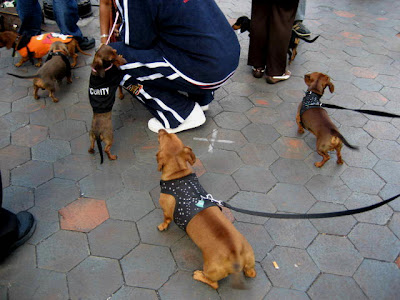
 There was much more. Not just the usual New York sights, but quirky stuff you don't expect to find but aren't all that surprised by either, at least not in New York. Like the Dachshund rally in Washington Square.
 I'm looking forward to the Spring edition of the walk. Join us.
Posted by Jay Livingston
The New York Walk planners hadn’t checked their calendar. They scheduled it for the same day as the Montclair Homecoming Game, so we had fewer students than usual on the walk. (And as we walked around Manhattan, Montclair State was defeating Kean, 27-12.)
So we were a small group of tourists, something like these.

(These bronzes are at the clock at the Hilton Hotel just across from Port Authority - public art by Tom Otterness.)
It was a beautiful autumn day, and Bryant Park behind the Library was just beginning to fill up. The Library puts out books for people to read while the sit in the park. (The red shelf has books for kids.)
 I suppose there's something to be said sociologically about the trust and public spaces. Anybody could walk away with a book or two. Or a chair or table, for that matter. But I suspect that the attrition rate is low.
Bryant Park also has the cleanest pubic restrooms you can imagine. Laura Kramer, as she was leaving the women's room, complimented the custodian and asked a brief question (sorry, Laura, but I can't remember what it was), and the woman beamed and gladly answered. As Laura reminded us, though it shouldn't have been necessary, "People love to talk about their work."
Two of us were from Germany – Agnes, who was born in Poland, and Miriam – and they wanted East European food for lunch, so we stopped here.
 (Agnes and Miriam are on the left of the photo. The others, though it's hard to distinguish them in this photo, include George Martin, Laura Kramer, and Peter Freund.)
And speaking of work, you may be familiar with this famous photo by George Ebbets of construction workers having lunch, sitting on a girder high above the city. (I think they were working on the Chrysler Building in the early 1930s).

A sculptor has transformed the picture into metal, and he displays his work on a truck he parks on the street in Greenwich Village.

Here are Peter, Miriam, and Agnes getting a closer look.
 There was much more. Not just the usual New York sights, but quirky stuff you don't expect to find but aren't all that surprised by either, at least not in New York. Like the Dachshund rally in Washington Square.
 I'm looking forward to the Spring edition of the walk. Join us.
What Can I Do With an MA?
October 12, 2007
Posted by Jay Livingston
Undergraduates often ask what they can do with a degree. Students who go into graduate programs presumably have resolved that question. So without further comment, here's a sign I saw posted at a bookstore in New Haven last month. I've blacked out the phone number, though I'm not sure why.

Posted by Jay Livingston
Undergraduates often ask what they can do with a degree. Students who go into graduate programs presumably have resolved that question. So without further comment, here's a sign I saw posted at a bookstore in New Haven last month. I've blacked out the phone number, though I'm not sure why.

Scholarship as an Avocation
October 10, 2007
Posted by Jay Livingston
Max Weber wrote an essay about “Scholarship as a Vocation” (the more commonly used translation is “Science as a Vocation”). It’s a classic, but Weber, in focusing on the professionals, forgot about the hobbyists tinkering in their garages. Sometimes, they do it better.
When I was an undergraduate, there was a lab technician who worked for the biochemistry department – I don’t think he had a college degree, he may even have been a high school droupout – who knew more than most of the doctoral students and probably some of the faculty. He was also the quarterback on the biochem intramural football team, which is why they usually won.
I was reminded of this by two things this week: my sister-in-law’s birthday dinner and Andrew Gelman’s Social Science Statistic Blog.
Gelman prints a rant (his word, not mine) that someone sent him about a wrongheaded statistical analysis done by some consultant for a local government project.
Gelman agrees and adds:
Take Howie, a guy you would never mistake as an academic. He’s an old friend of my brother- and sister-in-law, and Sunday we were celebrating her birthday somewhere out in Queens at an unpretentious Italian restaurant (decent food, reasonable prices, no tablecloths, Yankees on a couple of TVs in the bar). I was seated down at the end of the table with my brother-in-law and Howie. Talk turned to politics – Hillary, Obama, Rudy – and what about Gore? That got us to Gore 2000 and the electoral college, then to Kerry and the Ohio vote in 2004. Were the elections stolen?
It became clear that Howie knew a lot about voting and irregularities and how you might audit results to detect vote-count tampering. He knew about sample sizes and statistical errors. He knew that no single sample size or percentage was perfect and that you optimize sample size by taking account of of electoral shifts and winning margins. He knew all the ways that a House bill on election audits was flawed. He also knew about hacking electronic voting machines, but he thought the computer scientists were focused on the wrong part of the problem. If you wanted to ensure voting integrity, you had to go for statistical audits. (“The computer science guys, they’re not interested in this stuff.”)
But as far as I knew, this was purely a hobby for him. It certainly wasn’t his job. (The last job he had was for an airline.) He had learned the statistics on his own – books, the Internet – after he’d gotten interested in the problem of election integrity. Now he’s publishing papers with academic co-authors and offering expert testimony on proposed federal legislation.
Posted by Jay Livingston
Max Weber wrote an essay about “Scholarship as a Vocation” (the more commonly used translation is “Science as a Vocation”). It’s a classic, but Weber, in focusing on the professionals, forgot about the hobbyists tinkering in their garages. Sometimes, they do it better.
When I was an undergraduate, there was a lab technician who worked for the biochemistry department – I don’t think he had a college degree, he may even have been a high school droupout – who knew more than most of the doctoral students and probably some of the faculty. He was also the quarterback on the biochem intramural football team, which is why they usually won.
I was reminded of this by two things this week: my sister-in-law’s birthday dinner and Andrew Gelman’s Social Science Statistic Blog.
Gelman prints a rant (his word, not mine) that someone sent him about a wrongheaded statistical analysis done by some consultant for a local government project.
Gelman agrees and adds:
This certainly doesn't surprise me: I've seen worse from paid statistical consultants on court cases, including one from a consultant . . . who reportedly was paid hundreds of thousands of dollars for his services.The people with credentials can be wrong. And sometimes the uncredentialed guys – like the lab technician – surprise you.
The key problems seem to be:
1. Statistics is hard, and not many people know how to do it.
2. The people who need statistical analysis don't always know where to look.
Take Howie, a guy you would never mistake as an academic. He’s an old friend of my brother- and sister-in-law, and Sunday we were celebrating her birthday somewhere out in Queens at an unpretentious Italian restaurant (decent food, reasonable prices, no tablecloths, Yankees on a couple of TVs in the bar). I was seated down at the end of the table with my brother-in-law and Howie. Talk turned to politics – Hillary, Obama, Rudy – and what about Gore? That got us to Gore 2000 and the electoral college, then to Kerry and the Ohio vote in 2004. Were the elections stolen?
It became clear that Howie knew a lot about voting and irregularities and how you might audit results to detect vote-count tampering. He knew about sample sizes and statistical errors. He knew that no single sample size or percentage was perfect and that you optimize sample size by taking account of of electoral shifts and winning margins. He knew all the ways that a House bill on election audits was flawed. He also knew about hacking electronic voting machines, but he thought the computer scientists were focused on the wrong part of the problem. If you wanted to ensure voting integrity, you had to go for statistical audits. (“The computer science guys, they’re not interested in this stuff.”)
But as far as I knew, this was purely a hobby for him. It certainly wasn’t his job. (The last job he had was for an airline.) He had learned the statistics on his own – books, the Internet – after he’d gotten interested in the problem of election integrity. Now he’s publishing papers with academic co-authors and offering expert testimony on proposed federal legislation.
Subscribe to:
Posts (Atom)